Last updated: 1 October 2026 · By Team Tilesminds
Building toys (also called construction toys) are toys that children use to build something themselves by combining separate pieces, such as building blocks, magnetic tiles or technical construction kits. They are open-ended toys with no fixed outcome, and they help children develop creativity, spatial awareness, fine motor skills and problem-solving through play.
In this article you will learn what types of construction toys there are, how they differ, which ages they suit and where STEM toys fit in.
In short
- Building toys = construction toys where your child decides what to make.
- Four main types: classic building blocks, magnetic building sets, technical construction kits and themed sets.
- Age: large blocks from 1 year, magnetic tiles from 3 years, technical construction kits usually from 6 years.
- STEM: many building toys are also STEM toys: children experiment with shapes, balance and engineering.
- Safety: look for the CE marking, the age label and securely enclosed magnets.
Contents
- What are building toys?
- What types of construction toys are there?
- Magnetic construction toys: how they work
- What are STEM toys?
- What does your child learn from building toys?
- Combining building and role play
- Safety, materials and quality marks
- Which building toys suit your child?
What are building toys?
Building toys (also known as construction toys or construction sets) consist of separate pieces that your child puts together to make something: a tower, a house, a vehicle or something that only exists in their imagination. The difference from many other toys: there is no fixed outcome. Your child decides what it becomes.
Characteristics of building toys:
- pieces that can be connected in different ways (stacking, clicking, screwing or with magnets);
- open-ended: the same materials become something different every time;
- they grow with your child: a toddler stacks, a school-age child builds entire cities;
- expandable: you can combine and add to sets.

What types of construction toys are there?
There are four main types of construction toys. They differ in how the pieces connect, which age they are intended for and what your child mainly practises with them.
| Type | How it connects | Age guide | What your child mainly practises |
|---|---|---|---|
| Classic building blocks (wood or plastic) | Stacking or clicking | From approx. 1 year | Gross and fine motor skills, balance |
| Magnetic building sets (tiles and blocks) | Magnets in the edges | From 3 years | Spatial awareness, shapes, 2D to 3D |
| Technical construction kits | Screws, axles, gears | Usually from 6 years | Engineering, logical reasoning, following instructions |
| Themed sets | Varies by set | Varies by set | Imagination, storytelling, goal-oriented building |
The ages are a guideline. Always follow the age label on the packaging, as it says something about safety (such as small parts), not just about difficulty.
Pro tip: Start with one type and expand once you see what your child gets excited about. Many sets can be combined with each other.
Magnetic construction toys: how they work
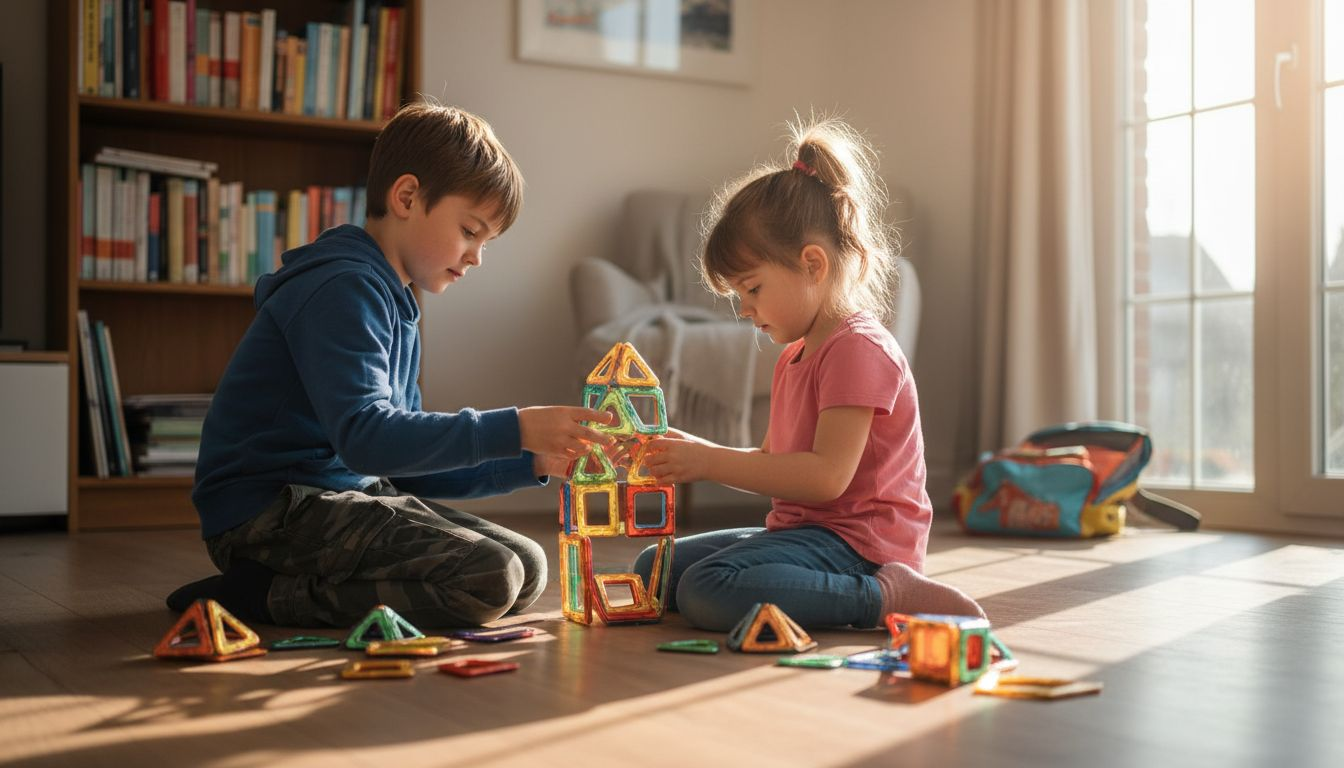
Magnetic construction toys consist of tiles or blocks with magnets in the edges. The magnets are positioned so that the pieces click together in any direction. That means your child does not have to line things up precisely and press: holding two tiles against each other is enough.
This makes magnetic building suitable for young children from age 3: they get quick results and stay motivated. At the same time, there is plenty of challenge for older children, who use the same tiles to build cubes, pyramids, castles and garages.
There are two main forms:
- Magnetic tiles: flat, often transparent shapes (squares, triangles) that let you build from 2D to 3D. For example the Magnetic Tiles 64 Pieces (€29.99).
- Magnetic blocks: small cubes that you stack into figures and worlds, for example in pixel style. For example the Magnetic Blocks 104 Pieces (Jungle) (€29.99).
Read more about what magnetic building does for your child's development in our guide to magnetic building.
What are STEM toys?
STEM stands for Science, Technology, Engineering and Mathematics. STEM toys are toys that let children experiment with these subjects through play. Many building toys fall into this category, because building is essentially "design and test".
For young children, STEM is not about coding, but about the basics:
- Shapes and geometry: six squares make a cube, four triangles make a pyramid.
- Balance and stability: why does a wide tower stay up better than a narrow one?
- Physics: magnets attract each other, but they can also repel each other.
- Counting and comparing: how many tiles do I need for a wall of the same height?
The big advantage over learning through a screen: your child is doing it themselves. They come up with a plan, test it, see it go wrong and adjust it. That is exactly the way of thinking STEM aims to encourage.
Pro tip: Now and then, set a small building challenge ("Build a bridge that a car can drive under") and let your child find the solution.
What does your child learn from building toys?
While building, your child practises lots of skills at once, without it feeling like learning:
- Creativity: deciding for themselves what to make and how.
- Spatial awareness: understanding how shapes fit together and what something looks like from another side.
- Fine motor skills: grasping, turning and placing pieces precisely.
- Problem-solving: "Why does it fall over, and how do I fix that?"
- Perseverance: starting again when something collapses is part of it.
- Cooperation: discussing, taking turns and sharing ideas when building together.
Want to combine building with other educational games? In 7 educational games for children you will find ideas for each age.
Combining building and role play
Building toys become even more fun when a story is added. A child builds a stable and puts animals in it, or makes a garage and drives cars in and out. That is role play: children act out situations and decide what the characters do and say.
Role play helps with language (describing what is happening), social skills (putting yourself in someone else's shoes) and imagination. By combining building and role play, your child plays for longer and with more focus. Think of sets with vehicles, such as the Magnetic Race Track Orbit 153 Pieces (€34.99), or building a castle and making up a story to go with it.
Safety, materials and quality marks
Toys sold in the European Union must carry a CE marking. With it, the manufacturer declares that the toy meets European safety requirements. These include the EN 71 standards, which set requirements for things like mechanical safety (such as small parts and sharp edges) and chemical substances.
What should you look out for yourself?
- CE marking on the packaging or the product.
- Age label: toys with small parts are not suitable for children under 3.
- Securely enclosed magnets: with magnetic toys, the magnets must not be able to come loose. More on that in Are magnetic tiles safe?
- Sturdy material without sharp edges or cracks.
Our magnetic tiles and blocks are made of non-toxic, recycled plastic, have strong magnets and are suitable from age 3. Read how to keep them clean and safe in Magnetic toy maintenance.
Pro tip: Check building toys for damage every now and then. Remove a cracked tile or block from the set straight away.
Which building toys suit your child?
- Under 3: large, sturdy building blocks without small parts.
- 3 to 5 years: magnetic tiles, such as the Magnetic Tiles 64 Pieces (€29.99). Quick results, lots of freedom.
- 5 years and older: larger or themed sets, such as the Magnetic Blocks 104 Pieces (Jungle) (€29.99) or the Orbit race track (€34.99).
- From approx. 6 years: technical construction kits with screws and gears, alongside free building.
Looking for concrete building ideas? In our guide to magnetic building projects you will find step-by-step projects. Unsure which brand of magnetic tiles to choose? See Comparing magnetic tiles 2026.
Frequently Asked Questions
What are building toys?
Building toys (construction toys) are toys that children use to build something themselves by combining separate pieces, such as building blocks, magnetic tiles or technical construction kits. They have no fixed outcome and encourage creativity, spatial awareness and fine motor skills.
What different types of construction toys are there?
The four main types are classic building blocks, magnetic building sets (tiles and blocks), technical construction kits with screws and gears, and themed sets. They differ in how they connect and which age they suit.
What are STEM toys?
STEM toys let children experiment with science, technology, engineering and maths through play. For young children it is about the basics, such as shapes, balance, counting and magnetism. Many building toys are also STEM toys.
From what age are building toys suitable?
Large building blocks are available from around 1 year. Magnetic tiles and blocks are usually suitable from 3 years, technical construction kits often from 6 years. Always follow the age label on the packaging.
How do I choose the right building toys for my child?
Look at your child's age, interests and how much challenge they can handle. Start with a simple set that gives quick results and expand with larger or themed sets when your child wants more.