Last updated: 1 October 2026 · By Team Tilesminds
Good educational games for kids aged 3 to 6 include building with magnetic tiles, sorting games with colours and shapes, cooperative games, fine motor games with blocks, role play, themed play and puzzles. They work best when they feel like play rather than schoolwork: your child learns counting, shapes, cooperation and perseverance without even noticing.
In this article you'll find seven educational games with practical play ideas, an overview by age (3, 4, 5 and 6) and tips for guiding educational play at home without turning it into a lesson.
In short
- Educational play = play in which your child naturally practises something, such as counting, shapes, language or working together.
- The best educational games are open-ended, challenging and suited to your child's age.
- By age the focus shifts: from colours and shapes (age 3) to rules, counting and planning (ages 5–6).
- Guide with open questions and by joining in, not by giving the answers.
Contents
- 1. Building with magnetic tiles for spatial awareness
- 2. Learning colours and shapes with sorting games
- 3. Cooperating and sharing with board games
- 4. Practising fine motor skills with blocks
- 5. Role play for imagination and language
- 6. Themed play, such as cars and pixel blocks
- 7. Puzzles for logical thinking and perseverance
- Educational games by age
- How to guide educational play
Quick summary
| Game | What your child practises |
|---|---|
| 1. Building with magnetic tiles | Spatial awareness, shapes, creativity |
| 2. Sorting games | Colours, shapes, logical ordering |
| 3. Board games | Taking turns, cooperating, coping with losing |
| 4. Building with blocks | Fine motor skills, hand–eye coordination |
| 5. Role play | Language, imagination, empathy |
| 6. Themed play | Motivation, planning, storytelling |
| 7. Puzzles | Logical thinking, concentration, perseverance |
1. Building with magnetic tiles for spatial awareness
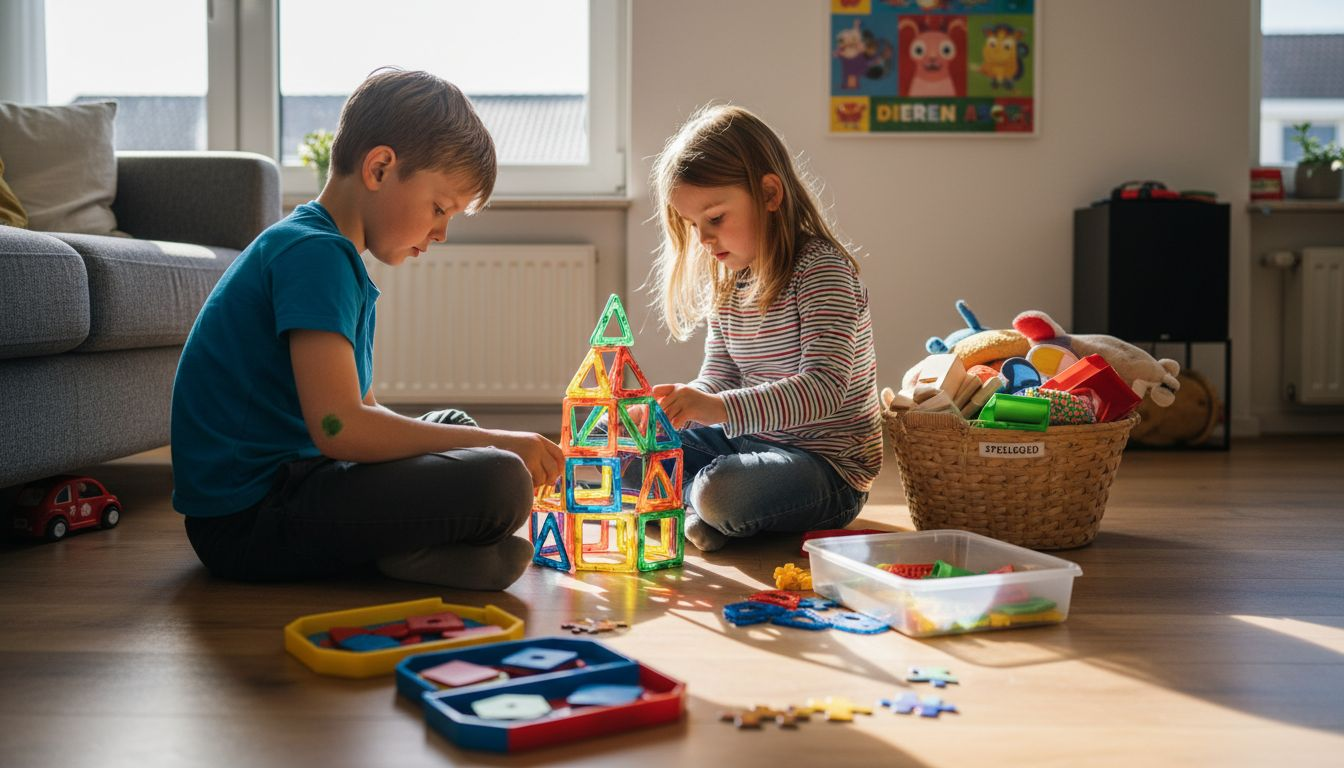
Magnetic tiles are one of the most fun educational games for preschoolers, because children can get started without any explanation. While building, they discover how shapes fit together: six squares become a cube, four triangles on a square become a pyramid. That's geometry, without it feeling like it.
Play ideas:
- Build a house together and count how many squares and triangles you need.
- Set a challenge: “Build a tower as tall as your knee.”
- Lay out patterns on the floor: red, blue, red, blue… what comes next?
A complete set to start with is the Magnetic Tiles 64 Pieces (€29.99). To read more about what building with magnets offers, see our guide to magnetic building.
Practical tip: Ask open questions such as “How could you make this tower even taller?” instead of showing them how.
2. Learning colours and shapes with sorting games
Sorting is one of the first forms of logical thinking. Children learn to make groups (all the red ones together, all the triangles together) and to explain why something does or doesn't belong in a group. Along the way they also practise the names of colours and shapes.
Play ideas:
- Sort tiles, blocks or buttons by colour, then by shape.
- Go on a “colour hunt”: find three things around the house that are just as blue as this tile.
- Count and sort: which pile is the biggest?
Practical tip: Let your child come up with a sorting rule and you guess what it is. That makes the game extra challenging.
3. Cooperating and sharing with board games
Board games teach children to wait their turn, follow rules and cope with winning and losing. Cooperative games in particular, where all players win or lose together, are well suited to young children: nobody is on their own.
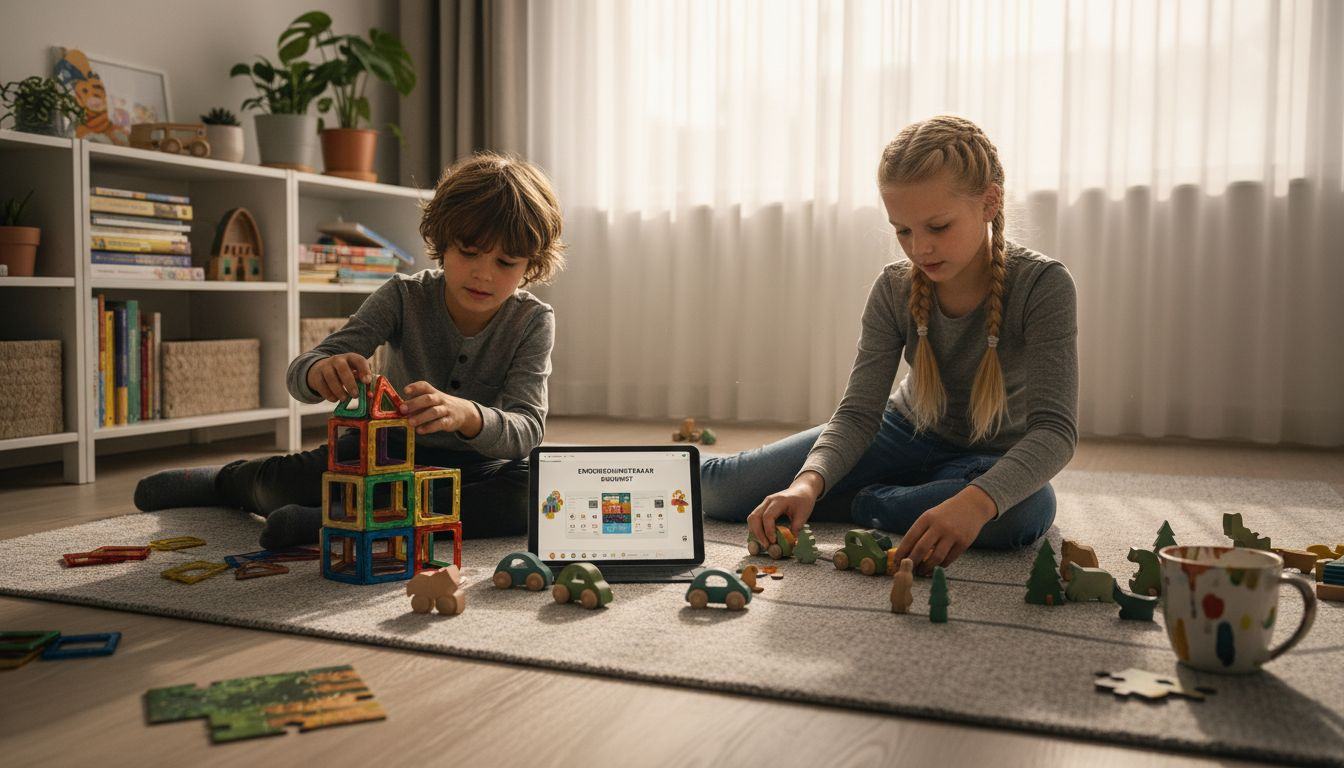
Building together works the same way: taking turns to place a tile, deciding together what it will become and giving each other's ideas a chance.
Practical tip: Choose short games for young children. A preschooler will stick with a 10-minute game much better than one that lasts half an hour.
4. Practising fine motor skills with blocks
Fine motor skills are the small movements of the hands and fingers. Your child will need them later for drawing, cutting and writing. Building with small blocks is good practice: picking up, turning and placing precisely.
Play ideas:
- Copy a figure from an example (simple at first, then harder).
- Build as high as possible without it toppling over.
- Make an animal or a little figure out of blocks together.
Magnetic blocks are handy for this because they stay stuck together. For example, the Magnetic Blocks ICE 118 Pieces (€29.99).
5. Role play for imagination and language
In role play, children pretend: they're a doctor, a teacher, a knight or a shopkeeper. They make up what the characters say and do, and in doing so practise language, imagination and putting themselves in someone else's shoes.
Role play and building go well together. First build a castle, a shop or a zoo, then play out a story in it. A set with a clear theme (a castle, a garage, a zoo) gives an easy starting point.
Practical tip: Take on a role yourself, but let your child stay in charge of the story.
6. Themed play, such as cars and pixel blocks
A theme your child loves works as motivation. A child who is mad about cars would rather build a garage than a stand-alone tower. A child who loves blocky worlds wants to build them with real blocks too.
The theme gives the game a goal (“the car has to fit in the garage”), and that teaches your child to plan and design. Examples: the Magnetic Blocks 104 Pieces (Jungle) (€29.99) for pixel-style building, or the Magnetic Race Track Orbit 153 Pieces (€34.99) for car lovers.
7. Puzzles for logical thinking and perseverance
Puzzles teach children to solve a problem step by step: first the edges, then the colours. They practise concentration and experience how good it feels when something finally works out.
You can also make “building puzzles”: build a simple figure out of tiles or blocks and let your child copy it. Or set a challenge: “Can you make a cube using only triangles?”
Practical tip: Choose a puzzle just above your child's current level and only help when they're really stuck.
Educational games by age
| Age | What your child is working on | Suitable games |
|---|---|---|
| 3 years | Colours, shapes, “doing it myself” | Sorting by colour, simple building with tiles, short role-play games |
| 4 years | Imagination, playing together, counting to 10 | Building together, simple board games, 20–30 piece puzzles |
| 5 years | Rules, planning, patterns | Building from an example, cooperative games, making patterns |
| 6 years | Strategy, designing, longer tasks | Big building projects, strategy games, designing a race track or a town |
Every child develops at their own pace. Use the table as a guide and, above all, look at what your child enjoys.
How to guide educational play
- Choose toys that suit your child's age and interests.
- Set up a regular play area with enough space on the floor or at the table, and a box for tidying up.
- Keep rules to a minimum and let your child explore freely first.
- Join in and ask open questions: “What are you going to build?” “What happens if…?”
- Notice what your child enjoys and build on it with a new challenge or an extension.
Curious which toy trends fit in with this year? Read 7 popular toy trends for 2026.
Frequently Asked Questions
What are good educational games for 3 year olds?
For 3-year-olds, simple games with colours and shapes work best: sorting, building with magnetic tiles, short role-play games and large puzzles. Keep it short and, above all, let your child discover things for themselves.
Which educational games suit children aged 4 to 6?
From age 4, children can build together, play simple board games and make patterns. Around ages 5 and 6, games with rules and strategy suit them, as do bigger building projects based on an example or their own design.
What are the benefits of playing educational games?
Educational games practise skills such as counting, shapes, language, fine motor skills and cooperation while your child is simply playing. That keeps motivation high, and learning doesn't feel like schoolwork.
Which educational games help develop social skills?
Cooperative games, role play and building together help the most. Children learn to take turns, talk things through, compromise and deal with winning and losing.
How do I guide educational play without turning it into a lesson?
Join in, ask open questions and let your child stay in charge. Only offer a new challenge when your child asks for one or starts to lose interest in the game.
Read more
- What are construction toys? Types and STEM explained
- Magnetic building: what magnetic tiles do for your child
- 7 popular toy trends for 2026
Read more:
Read more: