Last updated: 1 October 2026 · By Team Tilesminds
The seven biggest toy trends of 2026 are magnetic building toys, sustainable toys, STEM toys, themed sets (such as Minecraft-style blocks and cars), safer materials, toys for fine motor skills and digitally connected toys. The common thread: parents are choosing open-ended toys that last for years, are safe and offer a real alternative to screen time.
In this article you’ll find, for each of these trending toys of 2026, what the trend is, why it’s popular and what to look for as a parent. Where it fits, we show how you can bring the trend into your home with magnetic toys.
In short
- Magnetic building is the biggest trend: open-ended toys that let children from age 3 decide for themselves what to build.
- Safety and materials matter more because of the new EU Toy Safety Regulation, which bans PFAS and the most harmful bisphenols, among other things.
- Themed sets (Minecraft-style blocks, race tracks, cars) make building extra appealing for children who would otherwise reach for a screen.
- Combining is smart: sets that work together grow with your child, so you can start small and expand later.
Contents
- 1. Magnetic toys: building with imagination and ease
- 2. Choosing sustainable, eco-friendly toys
- 3. STEM toys: learning through play and experimenting
- 4. Themed sets like Minecraft and cars for extra fun
- 5. Toy safety: BPA-free and sturdy materials
- 6. Developing fine motor skills through play
- 7. Digitally connected toys: educational and interactive
Quick summary
| Toy trend 2026 | Why it matters |
|---|---|
| 1. Magnetic toys | Open-ended play: children decide what to build while practising spatial awareness and fine motor skills. |
| 2. Sustainable toys | Fewer but better: toys that last for years and are made from carefully chosen materials. |
| 3. STEM toys | Children experiment with balance, shapes and cause and effect without it feeling like learning. |
| 4. Themed sets | A familiar theme gives building a goal and a story, and keeps children engaged for longer. |
| 5. Safety | New EU rules ban more harmful substances; check the age label, materials and securely enclosed magnets. |
| 6. Fine motor skills | Picking up, turning and placing pieces precisely trains the small muscles in hands and fingers. |
| 7. Digitally connected toys | Growing fast, but works best as an addition to physical play, not a replacement. |
1. Magnetic toys: building with imagination and ease
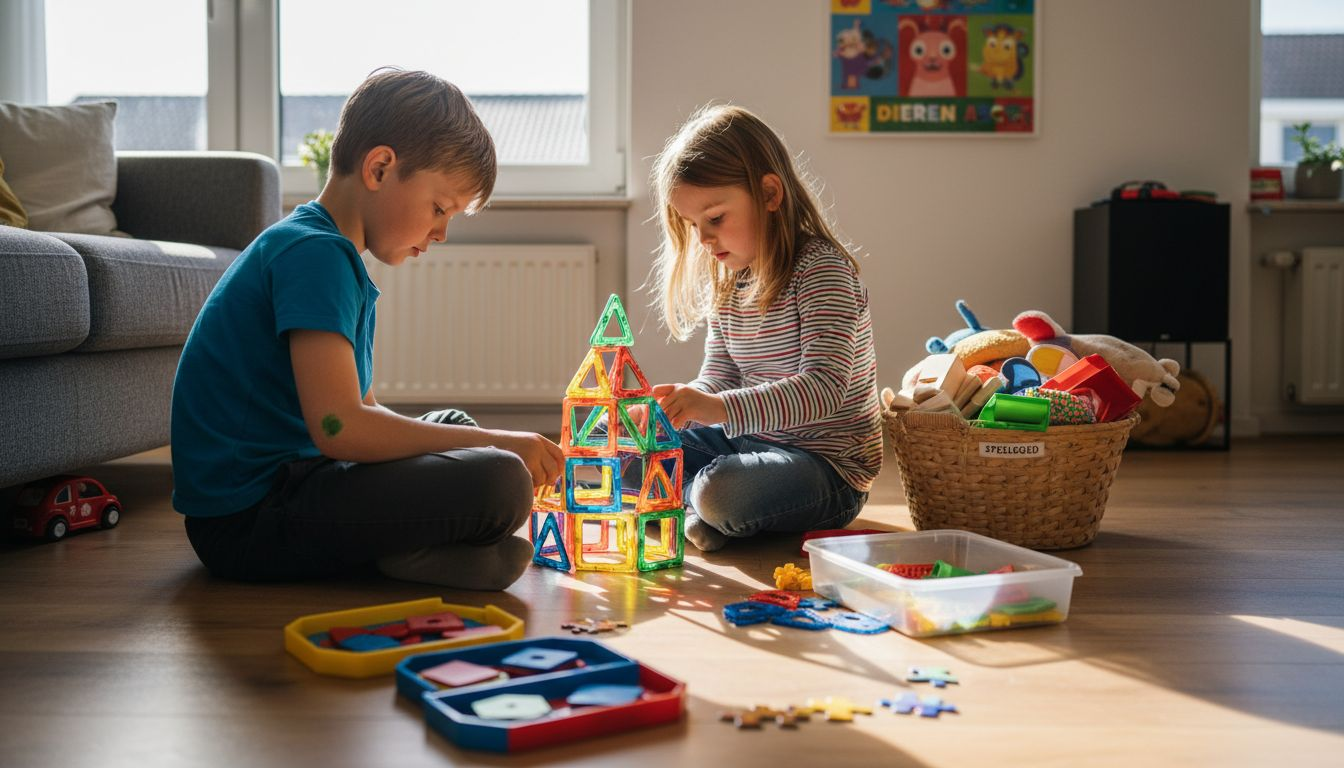
Magnetic toys are the toy trend of 2026 because they are open-ended: there is no right or wrong, only “what shall I build today?”. Tiles and blocks click together on their own, so even a 3-year-old gets results quickly, while an 8-year-old builds entire castles and garages with them.
While building, your child is practising, without noticing:
- spatial awareness (how does a flat surface become a cube or a pyramid?);
- fine motor skills and hand-eye coordination;
- problem solving (why does my tower fall over?);
- persistence and trying again.
A big advantage is that magnetic sets grow with your child. Your youngest starts with flat shapes on the floor; your oldest builds a three-dimensional city with the same tiles. So feel free to start small with a basic set, for example the Magnetic Tiles 64 Pieces (€29.99), and expand later with the Magnetic Tiles 125 Pieces (€42.00) when your child wants to build bigger.
Read more about what magnetic building does for your child’s development in How magnetic building brings your child’s imagination to life.
Pro tip: Give few instructions at first. Let your child experiment freely; the best builds often happen when you don’t tell them what to make.
2. Choosing sustainable, eco-friendly toys
In 2026, sustainable toys mainly mean: buy less, but better. Parents increasingly choose toys that are played with for years and can be passed on to a brother, sister or friend, instead of cheap items that end up in the cupboard after a week.
What should you look for?
- Material: what is it made of, and is the brand open about it?
- Durability: is it sturdy enough to last for years?
- Play value: can your child do something different with it at different ages?
- Expandable: can you add to it later instead of starting again?
At Tilesminds we make our tiles and blocks from recycled plastic. Why we chose this, you can read in Why Tilesminds is made from recycled plastic.
Pro tip: Involve your child in the choice and explain why you take good care of toys. Children who are involved often treat their toys more carefully.
3. STEM toys: learning through play and experimenting
STEM stands for Science, Technology, Engineering and Mathematics. STEM toys let children experiment with these subjects through play. For young children it’s not about robots or coding, but about the basics: recognising shapes, counting, symmetry, balance, and cause and effect.
Good STEM toys:
- challenge without frustrating;
- leave room for your child’s own ideas (open-ended);
- grow in difficulty;
- invite “what happens if…?”.
Magnetic tiles are an accessible form of STEM: children discover that six squares make a cube, that a wide base makes a taller tower possible and that magnets attract and repel each other. Want to know which types of building toys exist and what each one offers? Read What are building toys?
Pro tip: Ask open questions while playing, such as “How could you make this taller?”, instead of giving the answer.
4. Themed sets like Minecraft and cars for extra fun
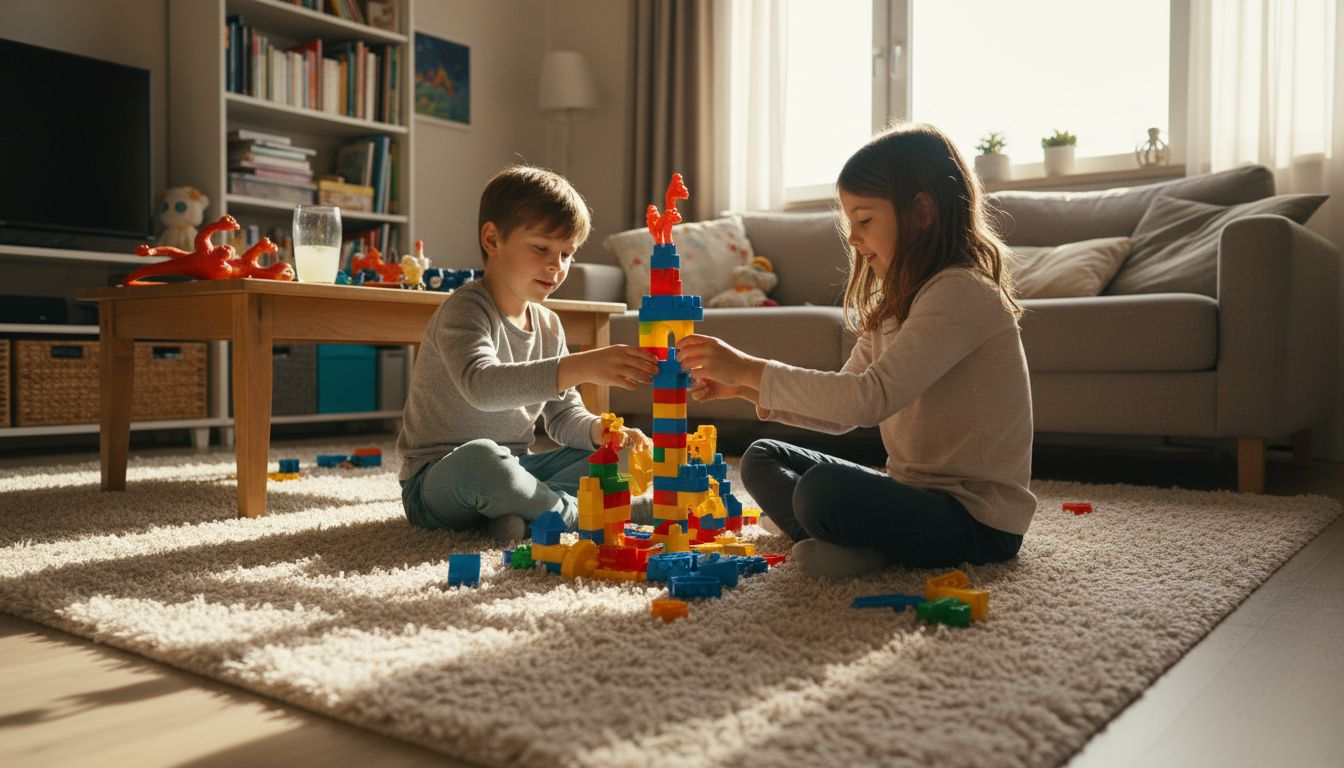
Themed sets are among the most popular trending toys because they connect with what children already love. A child who enjoys building a block world in a game wants to build that world with real blocks too. And a child who loves cars would rather build a race track than a single tower.
A theme gives building a goal and a story: “I’m building a cave for my figure” or “Which road is fastest for my car?”. That keeps children playing longer and with more focus.
Two examples from our range:
- Magnetic Blocks 104 Pieces (Jungle) (€29.99): pixel-style blocks, like the ones you know from Minecraft, that snap together with a magnetic click.
- Magnetic Race Track Orbit 153 Pieces (€34.99): tiles, bridges and a moving car to build your own race track.
Everything about building with magnetic blocks can be found in Why magnetic blocks are essential for children.
Pro tip: Let your child choose the theme and ask what they want to build. Ownership keeps the game going longer.
5. Toy safety: BPA-free and sturdy materials
Safety is in the spotlight in 2026 because of the new EU Toy Safety Regulation. According to the European Parliament, the new rules ban, among other things, the intentional use of PFAS and the most harmful bisphenols (such as BPA) in toys, and every toy will get a digital product passport with safety information. Companies get a transition period to adapt.
What should you check when buying (magnetic) toys?
- Age label: stick to the age shown on the packaging.
- Enclosed magnets: magnets must be securely fixed inside the toy and must not be able to fall out.
- Sturdy material: no sharp edges and no parts that break easily.
- Check regularly: throw away damaged parts and always keep loose magnets out of children’s reach.
Our tiles and blocks are made from non-toxic, recycled plastic, have strong magnets and are suitable from age 3. How to keep magnetic toys clean and safe is explained in Magnetic toy maintenance: keeping them safe and clean. What to do if a child does swallow a magnet is covered in Are magnetic tiles safe?
Pro tip: After a big building session, quickly check that no tiles are cracked. Remove a damaged tile from the set straight away.
6. Developing fine motor skills through play
Fine motor skills are the small movements of hands and fingers: grasping, turning, placing precisely. Your child will need these later for drawing, cutting and writing, and they develop best through play.
Good ways to practise fine motor skills:
- building with small blocks or tiles;
- threading beads;
- cutting and gluing;
- doing puzzles;
- building together, taking turns to place a piece.
Magnetic building is especially suitable, because your child has to turn blocks and tiles until the magnets “click”. Combine blocks and tiles and your child also practises spatial awareness: a flat tile becomes a roof, a block becomes a chimney.
Building together also helps social skills: discussing, taking turns and agreeing on what the castle should look like.
Pro tip: Alternate between types of activity (building, cutting, threading) so your child practises fine motor skills in different ways.
7. Digitally connected toys: educational and interactive
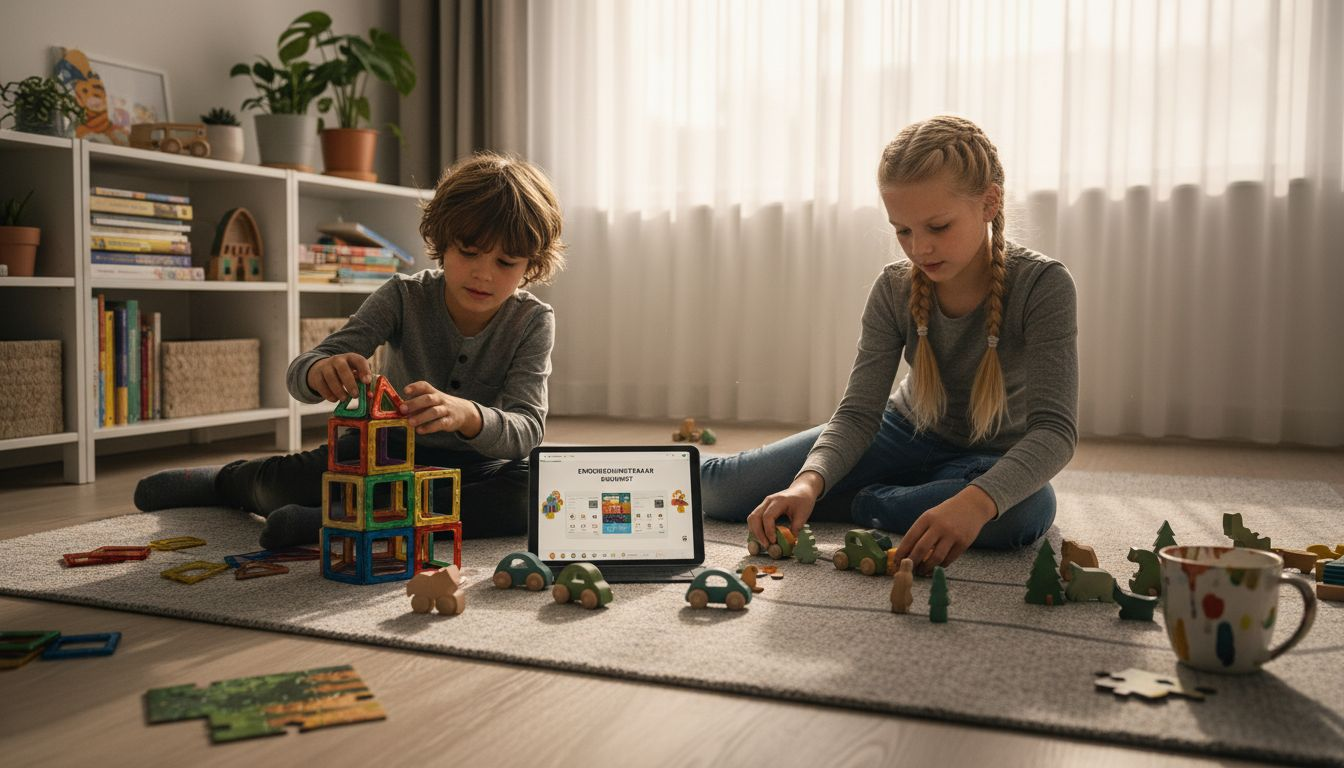
Digitally connected toys, such as toys with an app, sound or coding features, are growing in popularity. They can be educational, but many parents are looking for a balance with screen time.
What should you look for in digital toys?
- Does your child have to do something (build, think, move), or mostly watch and tap?
- Does it suit your child’s age?
- Do you know what data the app collects?
- Does it also work without a screen?
Use digital toys as an addition to physical play, not a replacement. Looking for a screen-free alternative that’s just as engaging? Read Why magnetic tiles are the perfect alternative to screen time.
Pro tip: Agree on fixed screen times and keep building toys within reach, so there is always an attractive alternative ready.
Below is an overview table of the seven toy trends of 2026, their features and what they offer for your child’s development.
| Toy type | Features | Benefits |
|---|---|---|
| Magnetic toys | Tiles and blocks click together on their own; open-ended | Creativity, spatial awareness and fine motor skills |
| Sustainable toys | Last for years, carefully chosen materials | Less waste, longer play |
| STEM toys | Experimenting with shapes, balance and cause and effect | Technical insight and problem solving |
| Themed sets | Familiar worlds such as pixel-style blocks, race tracks and cars | More engagement and imagination |
| Safe materials | Stricter EU rules, enclosed magnets, right age | Peace of mind without unnecessary risks |
| Fine motor skills | Building, threading, cutting and puzzles | Dexterity and hand-eye coordination |
| Digitally connected toys | Combine technology with play | Educational as an addition to physical play |
Which magnetic set suits your child?
Want to bring several 2026 toy trends into your home at once? Magnetic toys combine open-ended building, STEM and themed play. A quick guide:
- First set, from age 3: Magnetic Tiles 64 Pieces (€29.99).
- Big builds or several children: Magnetic Tiles 125 Pieces (€42.00).
- Fans of Minecraft-style block worlds: Magnetic Blocks 104 Pieces (Jungle) (€29.99).
- Car lovers: Magnetic Race Track Orbit 153 Pieces (€34.99).

All sets are made from non-toxic, recycled plastic, have strong magnets and are suitable from age 3. See the full range in all products.
Frequently Asked Questions
What are the benefits of magnetic toys for children?
Magnetic toys develop creativity, spatial awareness, fine motor skills and problem solving. Because tiles and blocks click together on their own, young children get results quickly, while older children build complex structures.
How do I choose sustainable toys for my children?
Choose toys that last for years, grow with your child and can be expanded. Check what they are made of and whether the brand is open about it. One sturdy set you add to is better than constantly buying new toys.
What are STEM toys and how do they help my child’s development?
STEM toys let children experiment with science, technology and maths through play. For young children it’s about the basics: shapes, counting, balance and cause and effect. Magnetic tiles are an accessible example.
Which themed sets are popular with children aged 5 to 12?
Sets inspired by games and vehicles are popular, such as Minecraft-style blocks, race tracks and cars. Choose a theme that matches your child’s interests; they’ll play longer and with more focus.
How can I develop my child’s fine motor skills with toys?
Choose toys that require small, precise movements, such as building with blocks or tiles, threading beads and puzzles. Vary the activities and build together now and then, taking turns.
What are the most important toy safety points?
Check the age label, sturdy material without sharp edges and (for magnetic toys) securely enclosed magnets. Under the new EU Toy Safety Regulation, PFAS and the most harmful bisphenols are banned, among other substances. Check toys regularly and remove damaged parts immediately.