
Every parent from Central Europe recognizes the joy of children curiously puzzling and building with magnetic toys. That's precisely why it's important to know how this unique physical force not only provides educational play but can also be used safely. In this article, you'll discover how magnetism works, the types of magnets used in toys, and how you can experiment safely and creatively with your child.
Table of contents
- What is magnetism and how does it work?
- Different types of magnets and their strength
- Practical examples from magnetic toys
- Safety of magnetic toys for children
- Creative and educational play with magnets
Important Points
| Point | Details |
|---|---|
| Magnetism basic concept | Magnetism is a force that attracts or repels certain materials without contact, resulting from the movement of electrons in atoms. |
| Types of magnets | There are four main types of magnets: permanent magnets, electromagnets, ferrite magnets, and neodymium magnets, each with unique properties and applications. |
| Safety in use | Safety is crucial with magnetic toys; pay attention to CE marking and the size of magnets to avoid risks such as swallowing. |
| Educational spectacle | Magnetic toys stimulate creative and exploratory learning, encouraging children to experiment and solve problems. |
What is magnetism and how does it work?
Magnetism is a fascinating physical force that can amaze and challenge children. It's a remarkable phenomenon in which certain materials can attract or repel each other without direct contact. Magnetic fields are essential for understanding this phenomenon.
At the atomic level, magnetism is created by the movement of electrons within materials. Each atom behaves like a tiny magnet, with electrons orbiting the nucleus, creating a small magnetic charge. In some materials, such as iron, these magnetic directions converge, creating a strong magnetic field.
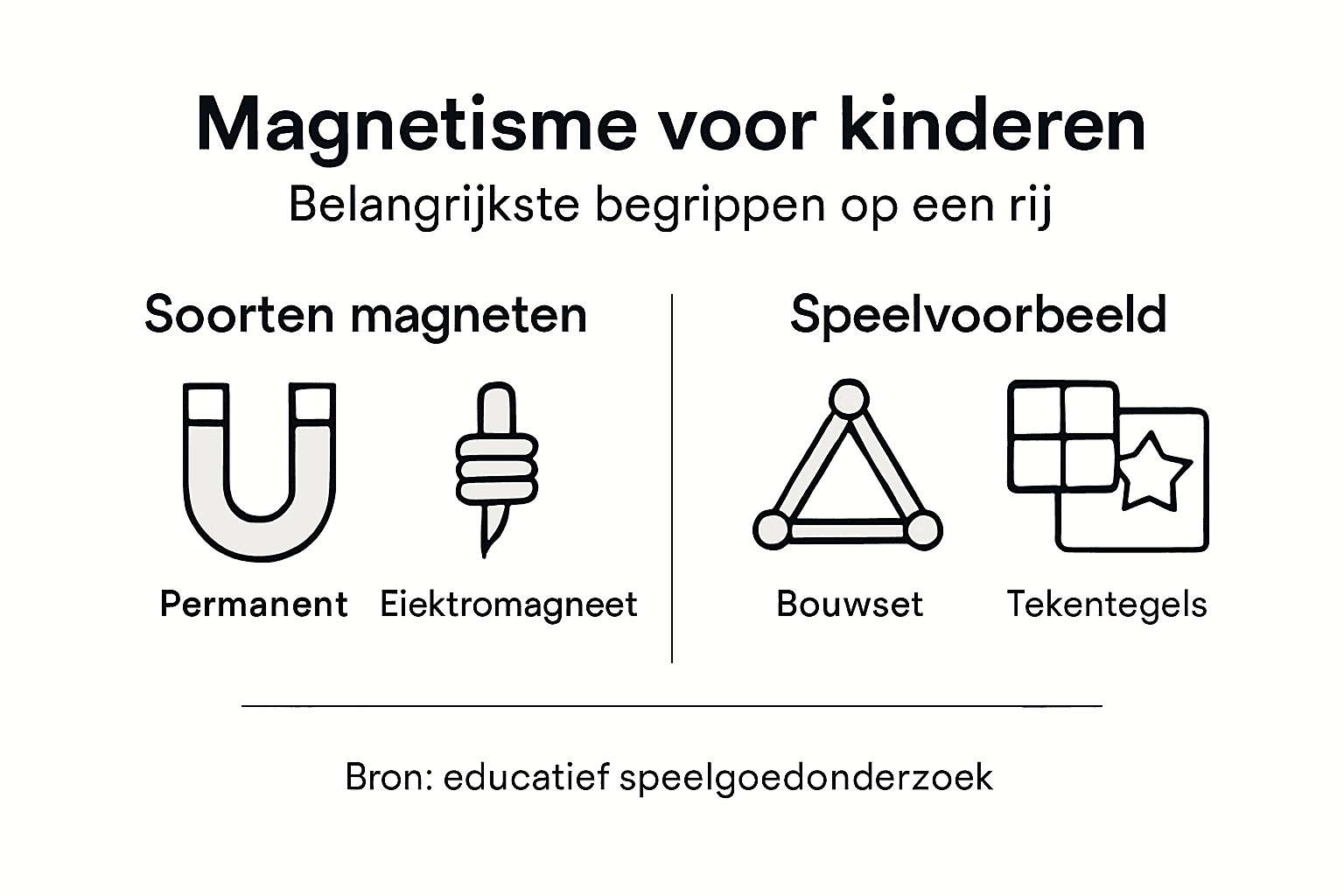
Magnets always have two poles: a north pole and a south pole. This leads to two fundamental rules of behavior:
- Like poles (north-north or south-south) repel each other
- Unequal poles (north-south) attract each other
These properties make magnets so interesting for children. They can experiment, build, and discover how objects can move together without physical contact.
Pro tip: Use magnetic toys to teach children the principles of physics in a playful way.
Different types of magnets and their strength
Magnets are not all the same. They differ in strength, material, and specific properties that make them suitable for different applications. Four main types of magnets form the basis of magnetic technology: permanent magnets, electromagnets, ferrite magnets, and neodymium magnets.
Each type of magnet has unique characteristics. Permanent magnets retain their magnetism independently, while electromagnets only become magnetic when an electric current passes through them. Ferrite magnets are ceramic magnets with good corrosion resistance, but less powerful than other types. Neodymium magnets are the most powerful permanent magnets and are used in situations where extremely strong magnetic fields are required.
Here are the key properties of different types of magnets:
Below you will find an overview of the four main magnet types and their typical applications:
| Type of magnet | Characteristic feature | Typical application | Material |
|---|---|---|---|
| Neodymium | Very powerful and compact | Electronics, model building, engines | Metal alloy |
| Ferrite | Good resistance to corrosion | Speakers, magnetic toys, displays | Ceramic material |
| Samarium cobalt | Resistant to high temperatures | Industrial motors, sensors | Metal alloy |
| AlNiCo | Very stable under temperature fluctuations | Measuring equipment, generators | Metal alloy |
- Neodymium magnets: compact, super strong, ideal for small spaces
- Ferrite magnets: robust, inexpensive, suitable for outdoor use
- Samarium-cobalt magnets: resistant to high temperatures
- AlNiCo magnets: stable under temperature fluctuations
The choice of a specific type of magnet depends on factors such as the desired strength, environmental conditions, and available space. Children can discover the unique properties of different magnets through experimentation.
Pro tip: Collect different types of magnets to show kids how their properties can vary.
Practical examples from magnetic toys
Magnetic toys offer children a great way to learn and play at the same time. Educational experiments with magnets make discovering physical principles fun and interactive. Magnetic building sets are ideal for letting children experiment with the forces of attraction and repulsion in a playful way.

Different types of magnetic toys encourage different skills. Magnetic tiles help develop spatial awareness and fine motor skills, while magnetic construction sets challenge children to think about stability and balance. These sets often feature various shapes such as triangles, squares, and rods that can be combined in countless ways.
Here are some practical possibilities with magnetic toys:
- Building 2D and 3D structures
- Making simple machines and mechanisms
- Discovering balance and symmetry
- Experimenting with attraction and repulsion
- Creating imaginative shapes and structures
By giving children freedom in their play, they can discover incredible things. Build a tower, construct a bridge, or create a complete fantasy vehicle—the possibilities are endless.
Pro tip: Introduce magnetic toys as an open-ended game where discovery and experimentation are key.
Safety of magnetic toys for children
Magnetic toys can be wonderfully educational, but safety is essential. European safety standards are crucial when selecting suitable toys for children. The CE mark indicates that the product meets basic safety standards, but full parental supervision remains essential.
There are several specific safety considerations for magnetic toys. Magnet size and attachment are critical factors. Loose magnets can be dangerous if swallowed, as they can attract each other in the digestive tract and cause serious medical complications. Parents must ensure that magnets are securely attached and cannot come loose.
Here are the most important safety guidelines for magnetic toys:
You can recognize safe magnetic toys by these criteria:
| Safety aspect | Why important? | Parental Checkpoint |
|---|---|---|
| Age recommendation | Prevents danger to young children | Read the packaging carefully |
| Confirmation of magnets | Avoid swallowing or dislodging | Magnets firmly in place and undamaged |
| CE mark | Complies with European standards | Look for the quality mark when purchasing |
| Size of loose parts | Prevents swallowing | Choose large, non-loose parts |
- Check age recommendation on packaging
- Make sure magnets are securely attached
- Choose toys without small loose parts for young children
- Avoid toys with damaged or loose magnets
- Supervise children while playing with magnetic toys
By making conscious choices and staying involved, parents can maximize the benefits of magnetic toys while ensuring safety.
Pro tip: Check magnetic toys regularly for damage and replace parts that are no longer safe.
Creative and educational play with magnets
Magnetic play is more than just an activity—it's a powerful way for children to learn through discovery. Magnets encourage exploratory learning in a playful and interactive way, perfect for children who love to experiment.
Through guided experiments , children can discover fundamental principles of physics. They learn about attraction and repulsion, symmetry and balance, while simultaneously developing their spatial awareness and problem-solving skills. Building structures with magnetic elements challenges children to think creatively and consider stability and design.
Possible creative magnetic activities:
- Building a magnetic course
- Making floating objects
- Constructing simple machines
- Designing symmetrical patterns
- Making magnetic paintings
- Carrying out mini-architecture projects
The most important thing is to give children the freedom to experiment, make mistakes, and try again. Every failed project is an opportunity to learn and develop new strategies.
Pro tip: Introduce magnetic challenges as open-ended play activities where discovery is more important than the end result.
Discover magnetism in a playful and safe way
Magnetism can sometimes be tricky to grasp, but with the right toys, learning becomes fun and inspiring for children. This article demonstrates the importance of using safe and educational magnetic toys that encourage experimentation with attraction and repulsion. Want your child to develop their creativity and fine motor skills while discovering the basic principles of magnetism? Our Magnetic Orbit and Magnetic Blocks offer endless building possibilities that perfectly align with these learning goals.
Choose durable toys with strong, safe magnets that are BPA-free and easy to use today. Encourage exploratory learning at home and give your child the opportunity to experience physics with fun. Visit TilesMinds and find the perfect magnetic toys that are inspiring and safe. Start building and exploring now.
Frequently Asked Questions
What is magnetism?
Magnetism is a physical force that allows certain materials to attract or repel each other without direct contact. This phenomenon arises from the movement of electrons in atoms.
How can children learn about magnetism with toys?
Children can learn about magnetism by using magnetic toys, such as building sets and tiles. This stimulates their creativity and helps them understand physical principles through experimentation.
What types of magnets are there?
There are four main types of magnets: permanent magnets, electromagnets, ferrite magnets, and neodymium magnets. Each type has unique properties and applications, ranging from household to industrial uses.
What are important safety aspects of magnetic toys?
Important safety aspects include the size and attachment of magnets, age recommendations, and CE marking. It's essential to choose toys that are safe for children, especially young children who could swallow them.