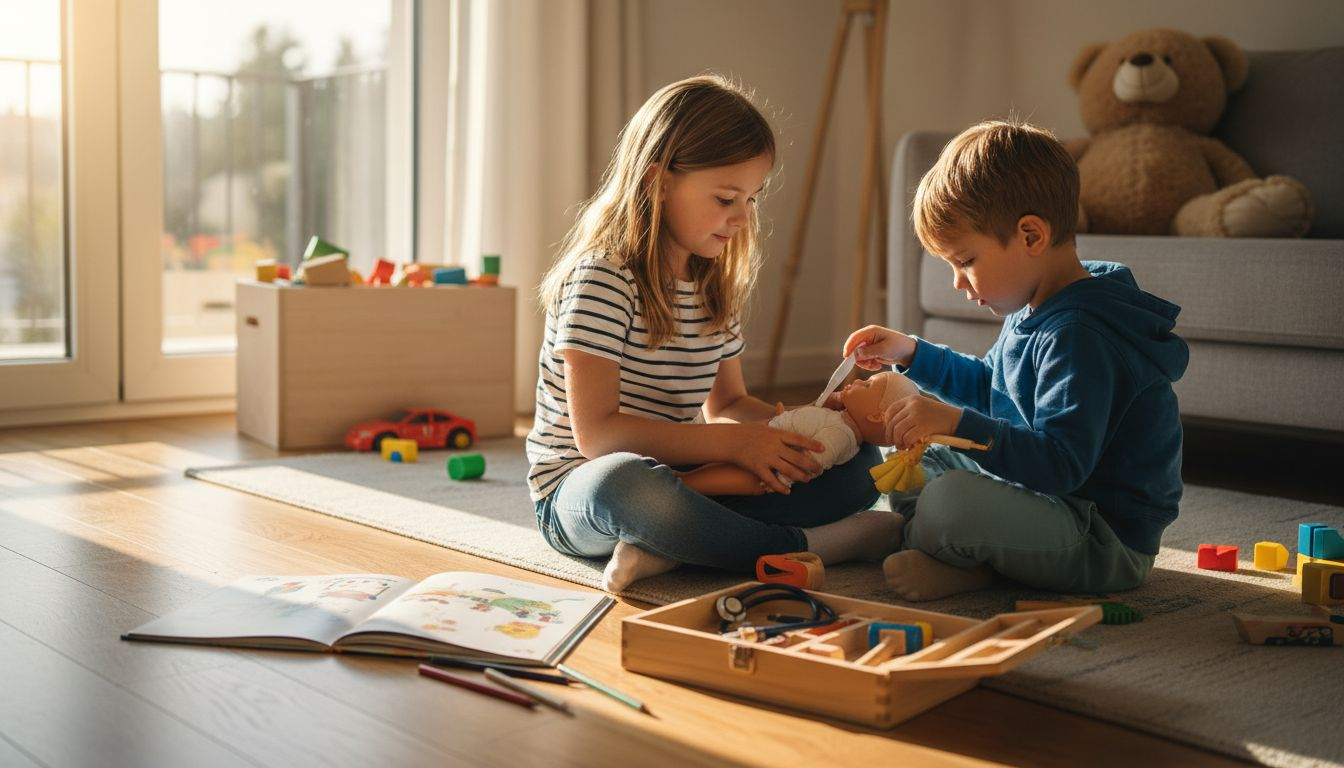
Every parent knows that moment when young children let their imaginations run wild, transforming the house into a shop, a hospital, or a castle. Experts say these moments of play with role-play toys are essential for developing social and emotional skills. For parents in Central Europe who value safety and creativity, educational toys like magnetic sets offer a safe play environment where children can freely experiment with roles, collaborate, and fully utilize their imaginations.
Table of contents
- What is role play toys and why are they important?
- Main Types and Themes of Role-Playing Toys
- How role-playing stimulates and develops children
- Magnetic role play toys: features and functions
- Safety requirements and European regulations for toys
- Common mistakes and safe selection by parents
Key Points
| Point | Details |
|---|---|
| Role-play toys promote development | It stimulates social skills, emotional intelligence and creative thinking in children. |
| Safety is essential when choosing toys | Always check CE marking and age recommendations to avoid risks. |
| Variation in themes is important | Choose role-play toys that represent different situations and professions to stimulate children's curiosity. |
| Magnetic toys offer unique possibilities | It enhances creativity and supports both cognitive and motor development through challenging play. |
What is role play toys and why are they important?
Role-play toys are a unique category of toys that allow children to simulate various social situations and roles. They go beyond mere play—they are an essential tool for early childhood development. Social skills are fostered by giving children the opportunity to explore and understand everyday scenarios.
The main purpose of role-play toys is to stimulate multiple aspects of development:
- Improve social skills
- Developing emotional intelligence
- Expanding language skills
- Sparking creativity and imagination
- Practicing problem-solving skills
Children use these playsets to practice complex social interactions in a safe environment. By pretending to be a doctor, teacher, or parent, for example, they learn how different social roles work. Role-playing serves as a kind of social training where children can experiment without real consequences.
Pretend play is essential for developing empathy and communication skills. Through this form of play, children learn how to cooperate, recognize feelings, and resolve conflicts.
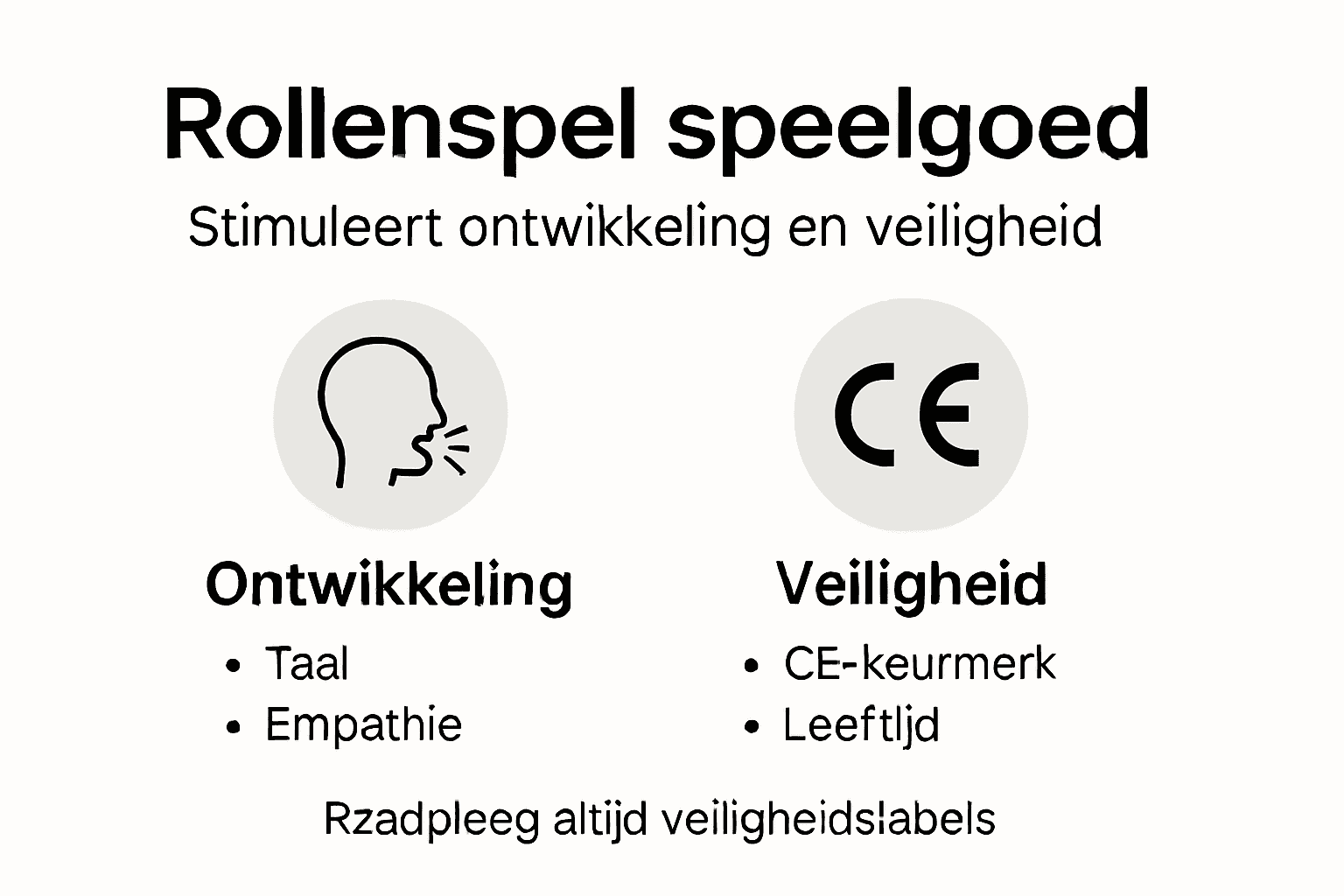
Pro tip: Choose role-play toys that represent different professions and situations to maximize children's development.
Main Types and Themes of Role-Playing Toys
Role-play toys offer children a rich collection of themes and play types that stimulate their development in various ways. Various role-play categories support children in exploring their social world and imagination.
The main types of role play toys include:
- Imitated role play : Children take on roles from their everyday lives
- Interactive role play : Playing together with other children
- Thematic role-playing : Based on specific stories or settings
- Material-based role play : Focused on the use of specific toy objects
The most popular themes in role-play toys are closely related to children's world of experience:
- Family and household
- Occupations such as doctor, teacher, police officer
- Shopping and errands
- Fantasy worlds such as fairy tales and castles
- Superheroes and adventure stories
Symbolic play develops gradually, allowing children to create increasingly complex scenarios and take on multiple roles. Different play types stimulate specific skills such as language skills, social intelligence, and problem-solving.
Pro tip: Vary the role-play toy themes to maximize children's curiosity and imagination.
How role-playing stimulates and develops children
Role-playing is a powerful developmental tool that helps children grow in multiple areas simultaneously. Developmental processes are stimulated by the unique way children can explore and understand social situations.
The main areas of development stimulated by role-playing:
-
Cognitive development
- Problem-solving thinking
- Logical reasoning
- Creative thinking
-
Social skills
- Communication
- Cooperation
- Empathy
-
Emotional intelligence
- Recognizing feelings
- Regulating emotions
- Building self-confidence
Language skills are particularly stimulated by role-playing, where children learn new words and develop communication skills. Role-playing enhances problem-solving skills by challenging children to explore different perspectives and practice complex social scenarios.

Here are the developmental areas along with their benefits and examples of role-play toys:
| Development area | Benefit for the child | Example role-playing toys |
|---|---|---|
| Cognitive | Stimulates logical thinking | Construction sets, doctor's bags |
| Social | Improves collaboration | Play shops, school sets |
| Emotional | Encourages empathy and self-regulation | Dollhouses, family figures |
| Language proficiency | Expand vocabulary | Fantasy stories, castle sets |
Role-playing creates a safe environment where children can experiment without real consequences.
Pro tip: Encourage role-play by asking open-ended questions and allowing children's imaginations to flourish.
Magnetic role play toys: features and functions
Magnetic role-play toys are an innovative category that encourages children to build and play creatively. Magnetic constructions offer unique developmental opportunities where children can explore their imaginations while developing important skills.
Key Features of Magnetic Role Play Toys:
- Strong neodymium magnets for stable constructions
- Versatile shapes and sizes
- Open-ended play character
- Easy to combine elements
- Safe and durable material
The functions of magnetic role play toys support multiple areas of development:
-
Cognitive development
- Spatial insight
- Problem-solving thinking
- Recognize geometric shapes
-
Motor skills
- Fine motor skills
- Hand-eye coordination
- Precise manipulation
Mathematical concepts are introduced through play by allowing children to experiment with symmetry, balance, and construction. The magnetic aspect makes play challenging and engaging, as children learn exactly how magnets work.
Magnetic toys create a dynamic play environment where each child can build their own story.
Pro tip: Combine magnetic role-play toys with story elements to further stimulate children's imaginations.
Safety requirements and European regulations for toys
Toy safety is a top priority in the European Union, with extensive regulations requiring manufacturers to meet strict standards. European safety standards protect children by setting detailed requirements for mechanical, chemical, and fire safety.
Main safety requirements for toys:
-
Mechanical safety
- No sharp edges
- Sturdy construction
- No small parts for young children
-
Chemical safety
- Restriction of harmful substances
- Ban on hormone-disrupting chemicals
- Strict material testing
-
Marking requirements
- Mandatory CE marking
- Clear age indication
- Warning labels
The new EU regulation introduces stricter controls, with a particular focus on online sales and imported products. Manufacturers must now provide a digital product passport that guarantees full traceability.
Every toy manufacturer must demonstrate that its product meets the highest safety standards.
Pro tip: Always check the CE marking and age recommendation before purchasing toys.
Common mistakes and safe selection by parents
Toy selection is a complex task for parents, involving much more than simply choosing a fun product. Common selection errors can pose risks to children's safety and development.
Common mistakes in toy selection:
- Age-inappropriate toys
- Not taking into account development stage
- Insufficient attention to safety labels
- No attention to material composition
- Ignoring warning labels
Important selection criteria for safe toys:
- Always check the age recommendation
- Please note CE marking
- Avoid small parts near young children
- Check material composition
- Pay attention to suitability for developmental stage
Safety aspects are crucial when selecting role-play toys. Parents should consider not only the attractiveness but also the safety and developmental value of the toy.
The table below helps parents assess safety and suitability when purchasing:
| Selection criterion | Why important | What to check |
|---|---|---|
| Age recommendation | Prevents unsuitable toys | Age on packaging |
| CE marking | Guarantees European security | CE logo visible |
| Material | Prevents harmful substances | Choose BPA-free material |
| Quality mark/warnings | Warns of risks | View quality mark information |
Each toy must be carefully assessed for safety and suitability for the child.
Pro tip: Consult independent consumer organizations and always look for official safety labels when purchasing toys.
Encourage imagination and safety with magnetic role play toys
Role-play toys help children develop important social and cognitive skills in a safe and creative environment. When choosing the right toys, it's essential to pay attention to safety and material quality. Magnetic toys like those on our site offer a unique blend of fun and education by allowing children to use their imaginations to create their own stories. Our strong magnets and durable materials ensure that children can play and explore carefree.
Discover our collection of Magnetic toys now and give children the space to enjoy safe and engaging role play. With our Magnetic Orbit sets and handy accessories , you'll not only stimulate creativity but also fine motor and problem-solving skills. Visit https://tilesminds.com today and choose the perfect magnetic toy that will help your child grow safely and with joy.
Frequently Asked Questions
What are the benefits of role-play toys for my child's development?
Role-play toys encourage social skills, emotional intelligence, language skills, creativity and problem-solving, which are essential for children's development.
What types of role-playing toys are there and what are their features?
There are different types of role-play toys, including imitative role-play, interactive role-play, thematic role-play, and material-based role-play, each with unique features that encourage different skills.
How can I safely select role-play toys for my child?
Always check the age recommendation, look for the CE marking, avoid small parts for young children and look at the material composition to avoid harmful substances.
What are the key areas of development stimulated by role-playing?
Role-playing improves children's cognitive development, social skills, emotional intelligence, and language skills, among other things, making them better prepared for social interactions in the real world.