You're looking for ways to help your toddler learn through play, but you often end up with the same old toys. Yet, you want your child to not only have fun but also develop important skills like teamwork, fine motor skills, and creativity. At the same time, you find it difficult to find toys that truly contribute to your child's development without quickly becoming boring.
The right approach can transform any playtime into a valuable learning experience. With practical examples, you'll soon discover how magnetic toys not only stimulate the imagination but also enhance collaborative play and learning. Each tip provides immediately applicable ideas for home or classroom use.
Be surprised by inspiring and clever ways to get the most out of magnetic toys. This way, you'll make the most of every building and play experience!
Table of contents
- Use magnetic toys to learn shapes and colors
- Encourage collaboration by building together
- Develop fine motor skills with small construction projects
- Promote spatial insight by emptying patterns
- Enhance imagination with thematic role-playing
- Learn to count and sort with play tiles
- Create learning moments with stories while building
Short Summary
| Core message | Explanation |
|---|---|
| 1. Use magnetic toys for learning | This toy helps children to discover shapes, colors and social skills through play. |
| 2. Encourage collaboration with construction activities | Joint construction assignments promote communication and respect for each other, which strengthens social skills. |
| 3. Develop fine motor skills with small projects | Small construction projects improve hand-eye coordination and precision, essential for motor development. |
| 4. Help children create patterns for spatial insight | Making patterns promotes logical thinking and visual discrimination, which is important for math skills. |
| 5. Encourage storytelling during construction | By combining stories with building, children develop language skills and creative thinking. |
1. Use magnetic toys to learn shapes and colors
Magnetic toys are a great way for preschoolers to explore shapes and colors in a playful and educational way. The magnetic pull of magnets allows children to learn interactively and creatively while playing.
Before children can recognize letters and numbers, they already understand shapes and colors. Magnetic toys offer a unique opportunity to support this natural learning process by:
- Let children discover different geometric shapes
- Introducing colors in a playful way
- Developing spatial insight through play
- Stimulate fine motor skills while building
The magnets encourage experimentation , allowing children to unknowingly acquire new skills. They learn, for example, that red triangles can stick to blue rectangles or that small squares can form larger structures.
To optimize the learning process, you can create different play formats together with your child. For example, have them build a tower using only red blocks or a boat with all square tiles. This way, learning truly becomes an adventure.
Expert tip: Vary the shapes and colors regularly to keep your child's curiosity engaged and the learning process interesting.
2. Encourage collaboration by building together
Cooperation is a crucial skill that can be developed at an early age. With magnetic toys, parents can help their preschoolers learn social skills through play .
Through collaborative building activities, children learn important collaboration skills:
- Improve communication
- Distribute tasks
- Listening to each other
- Achieving common goals
- Developing respect for each other's ideas
Team-building activities with construction toys encourage preschoolers to collaborate and think creatively. A simple challenge like "Can you build a tower taller than Daddy?" can motivate children to work together.
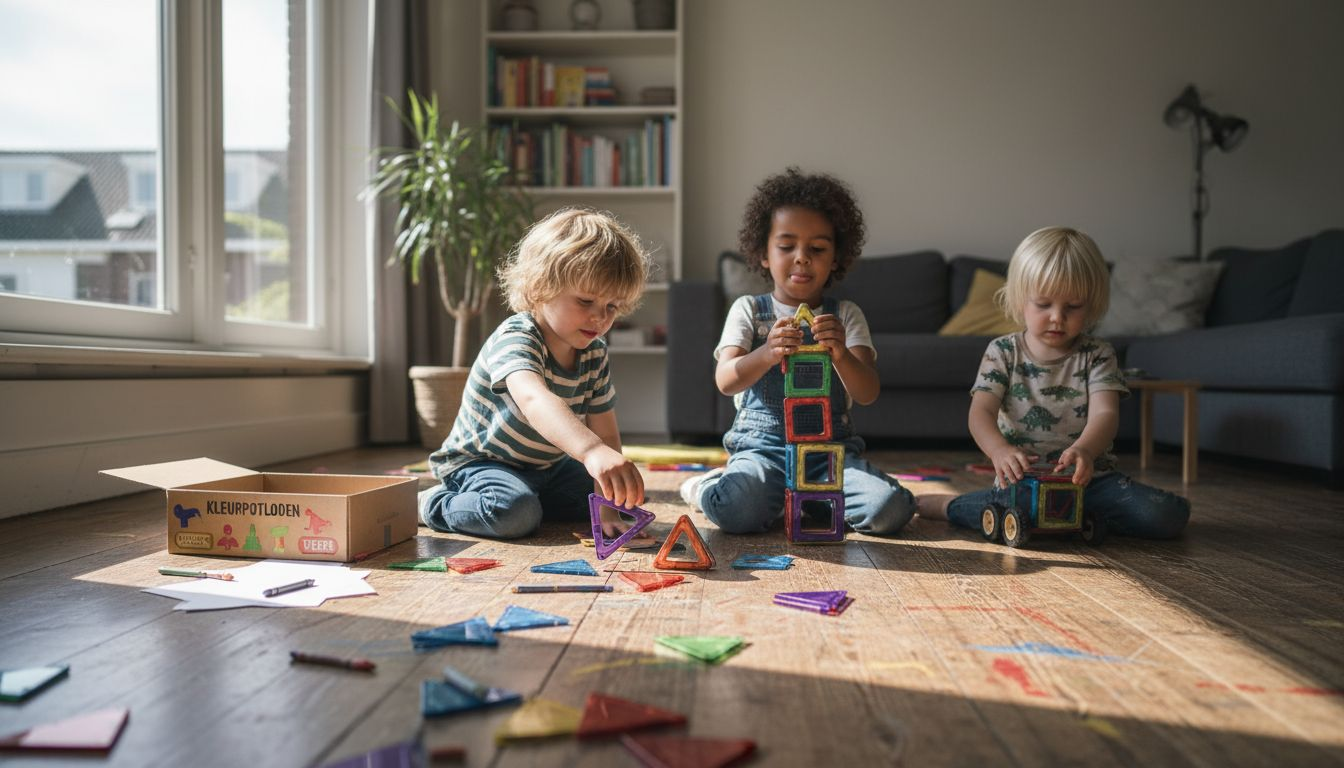
Involve several children in the building process and give them a shared challenge. For example, create a large structure or recreate a specific shape. This makes playing together fun and educational.
Building together is more than a game – it's an opportunity to develop social skills.
Expert tip: Change building partners regularly to encourage social interaction and teach children to work with different personalities.
3. Develop fine motor skills with small construction projects
Fine motor skills are essential for preschoolers, determining their future development. Small construction projects are the perfect way to improve these skills through play.
By making small constructions, children train important skills such as:
- Hand-eye coordination
- Spatial insight
- Finger dexterity
- Concentration ability
- Accuracy
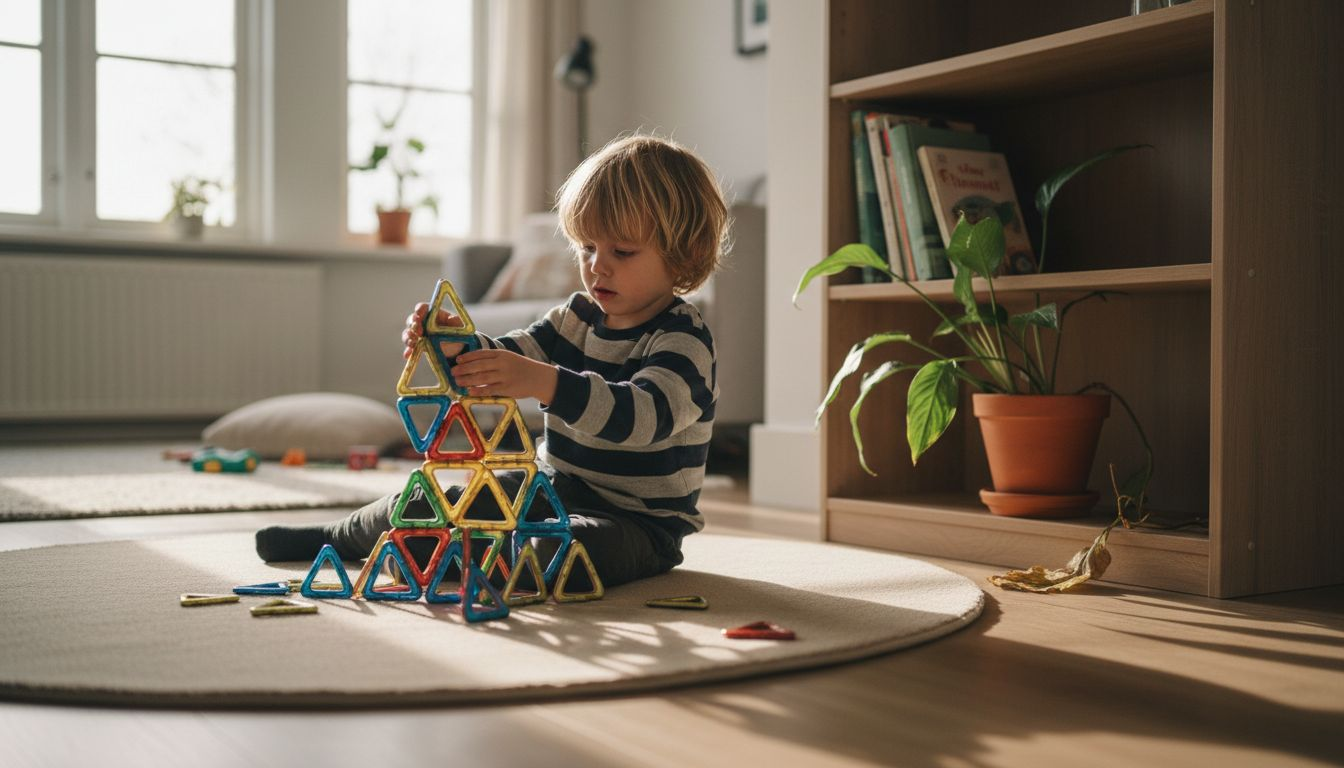
Magnetic toys are ideal for motor development activities because children can easily manipulate the blocks. Grasping and positioning small magnetic pieces requires precision and control.
Small actions lead to big developments in children's motor skills.
Provide challenging but achievable building projects. For example, build a small tower or recreate a simple figure. Provide positive feedback and encourage every small success.
Expert tip: Vary the building challenges regularly to broadly stimulate motor development and keep children engaged.
4. Promote spatial insight by creating patterns
Spatial awareness is a fundamental skill children need for later mathematical and problem-solving skills. Pattern-finding is key to developing this cognitive ability.
By making patterns, children learn:
- Recognizing shapes
- Understanding Symmetry
- Seeing logical connections
- Developing visual discrimination
- Stimulate abstract thinking processes
Magnetic toys are ideal because children can experiment with patterns without frustration. They can easily shift and repeat shapes without breaking them.
Every pattern a child creates is a small step toward great spatial insight.
Start with simple, symmetrical patterns like a rectangular row or a square structure. Encourage children to copy or even expand on patterns.
Expert tip: Use different colors and shapes to make patterns more challenging and fun, keeping kids motivated to experiment.
5. Enhance imagination with thematic role-playing
Role-playing is a magical way to spark preschoolers' imaginations and develop their social skills. Thematic play opens up new worlds for young explorers.
Through role-playing, children learn:
- Understanding different perspectives
- Developing emotional intelligence
- Improve communication skills
- Stimulate creative thinking
- Building self-confidence
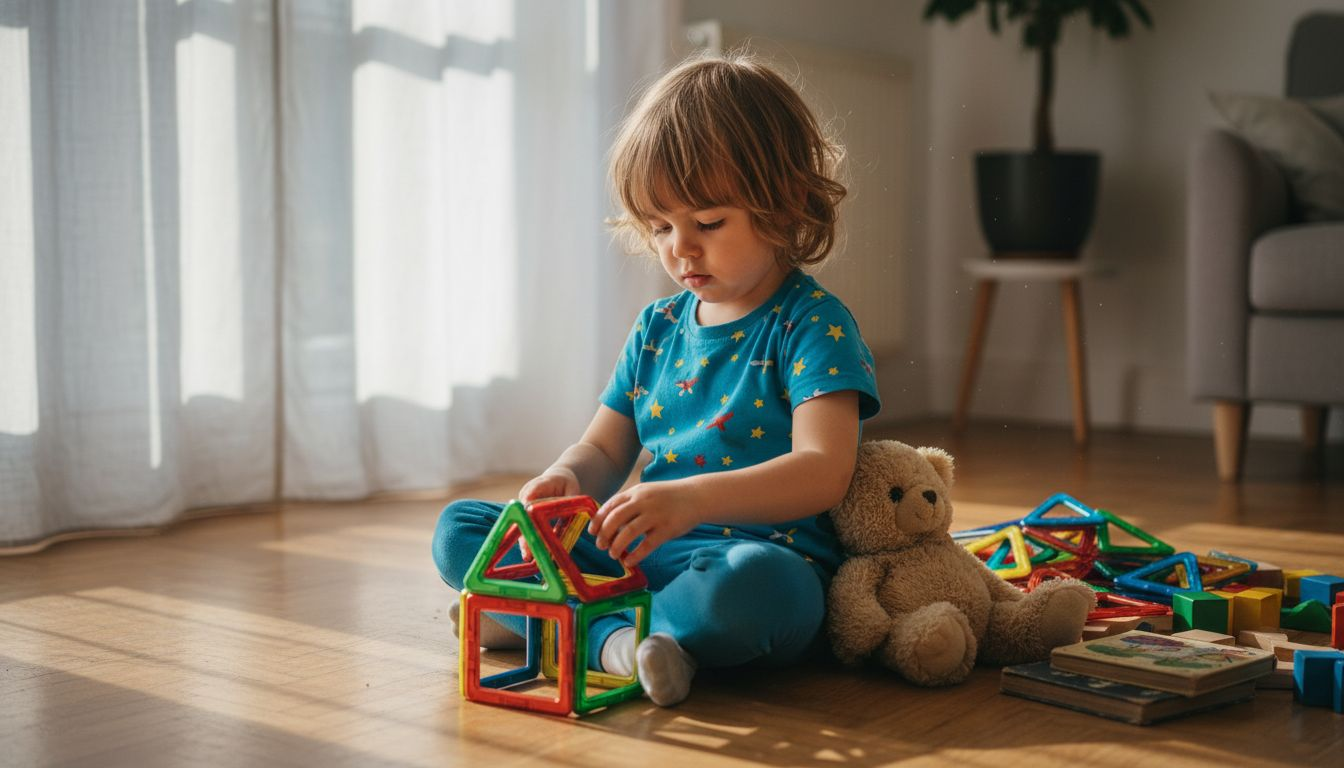
Magnetic toys can be a great help in this regard by supporting role play with concrete building activities . For example, children can build a hospital for doctoring or a space station for astronaut adventures.
Every role-playing game is a little journey full of discoveries and learning moments.
Create themed corners with different props. Let children decide what they want to act out and encourage them to make up stories.
Expert tip: Change themes regularly to keep children's imaginations stimulated and their skills engaged.
6. Learn to count and sort with play tiles
Magnetic play tiles are a great tool for teaching preschoolers to count and sort in a playful way. Math skills can be so much fun that children don't even realize they're learning.
By using play tiles, children can:
- Recognizing numbers
- Compare quantities
- Developing basic arithmetic skills
- Increase spatial insight
- Discovering patterns
The flexibility of magnetic tiles allows for a variety of learning games. For example, count how many blue tiles you can use or sort tiles by color and shape.
Don't just count numbers, build an adventure out of them.
Make counting fun by turning it into a game. Challenge children to build towers with a specific number of tiles or create patterns with different colors.
Expert Tip: Vary counting activities regularly to maintain children's interest and spark their mathematical curiosity.
7. Create learning moments with stories during construction
Storytelling while building is a great way to stimulate preschoolers' imaginations and language skills. Building becomes a true adventure when children create the stories behind their creations.
By combining stories with building, children develop:
- Language proficiency
- Creative thinking
- Storytelling skills
- Emotional intelligence
- Social interaction
Magnetic tiles are perfect because they help children create stories as tangible backdrops for their imaginations. For example, a castle for knights or a farm with animals.
Each block is a chapter. Each story is an adventure.
Encourage storytelling by asking questions like, "Who lives here?" or "What are they doing today?" Let children create their own scenarios.
Expert tip: Actively listen to your child's stories and encourage them to add more and more details.
The table below summarizes the key points and benefits discussed for using magnetic toys in various educational activities for preschoolers.
| Activity | Description | Advantages |
|---|---|---|
| Learning shapes and colors | Discovering geometric shapes and colors using magnets. | Promotes spatial insight and fine motor skills. |
| To collaborate | Building together and dividing tasks. | Develops social skills such as communication and cooperation. |
| Practicing fine motor skills | Making smaller constructions to promote hand-eye coordination. | Strengthens finger dexterity and precision. |
| Laying patterns | Experimenting with structures and symmetry. | Stimulates pattern recognition and spatial thinking. |
| Stimulate imagination | Using role-playing in combination with theme corners. | Promotes creativity and social-emotional development. |
| Learn to count and sort | Using play tiles to introduce math skills. | Improves number sense and logical connections. |
| Storytelling | Combining building with narrative activity. | Supports language development and creative thinking. |
Discover the fun of educational play with magnetic toys
Are you looking for a safe and versatile way to stimulate your toddler's imagination and fine motor skills? The tips in this article clearly demonstrate the importance of playfully practicing shapes, colors, collaboration, and counting. Magnetic toys make achieving these learning goals easy and fun. Our 125-Piece Magnetic Blocks and Tile sets are specially designed to support this process with durable, BPA-free materials that are safe for young children.
Don't wait any longer and give your child the gift of creative and educational play they deserve. Visit https://tilesminds.com today and discover our wide selection of magnetic toys. Choose a stimulating play experience where your toddler can learn and grow every day.
Frequently Asked Questions
How can I help my toddler learn shapes and colors with magnetic toys?
Use magnetic toys to playfully introduce different geometric shapes and colors. Encourage your child to build towers or other structures with specific colors and shapes, making learning more fun.
What are some ways to encourage cooperation while playing with magnetic toys?
Encourage your preschooler to collaborate with other children on collaborative projects, such as building a large tower. This helps them develop important social skills like communication and respect for each other's ideas.
Which small building projects are useful for developing fine motor skills?
Choose simple building projects like making a small tower or recreating a figure with magnetic toys. This improves hand-eye coordination and dexterity, and you can encourage the process with positive feedback.
How can I stimulate my toddler's spatial insight with magnetic toys?
Let your child create patterns with the magnetic tiles, which promotes their spatial awareness. Start with simple, symmetrical patterns and encourage them to expand or copy them, which strengthens logical thinking.
What are effective ways to stimulate my toddler's imagination during play?
Encourage thematic role-play by creating a story or scenario around their constructions. This allows children to express themselves creatively and further develop their social skills.
How can I make counting and sorting fun for my toddler with magnetic play tiles?
Use magnetic play tiles to create playful counting and sorting activities, such as sorting tiles by color or shape. Challenge your child to create a structure with a specific number of tiles, helping them develop their math skills through play.