If you are searching for Montessori toys for 4 year olds, you have probably noticed how much the label gets stuck on things. Wooden, beige, minimal: it all gets called Montessori. What matters more than the look is how a child plays with a toy. This guide explains what to look for, what to skip, and why one open-ended toy tends to earn its place on the shelf.
We keep it practical. You will find a short checklist, ideas for setting up play at home, and an honest look at which Tilesminds sets suit a four-year-old best.
What Montessori toys for 4 year olds really have in common
The Montessori approach is built around children learning by doing, at their own pace, with materials they can handle themselves. At four, many children want to do things on their own. They want to build, sort, pour, match and copy what they see you doing.
Toys that fit this approach usually share a few traits:
- They are open-ended. There is no single right way to play, so the toy does not run out of ideas.
- They are child-led. Your child decides what to make, and you do not need to press a button or follow a script.
- They are simple. A toy that does one thing gets used for one thing. A toy made of simple parts gets used for many things.
- They invite real concentration. Building, balancing and fitting pieces together asks for focus without anyone asking for it.
- They are easy to tidy. When a child can put a toy away without help, that is part of the learning too.
Notice that none of this depends on a material or a brand. It depends on how the toy gets used. That is why a set of magnetic tiles can fit the idea well even though it looks nothing like a classic wooden puzzle.
What changes at age four
Three-year-olds often stack, knock down and repeat. By four, many children start planning before they build. You might hear things like “I am making a garage for my cars” or “this is a castle, and this is the door.”
That shift is useful when you choose toys. A four-year-old can get more out of a toy that grows with the idea, rather than one that is finished the moment it is assembled. Look for something that supports:
- Building a plan, then changing it halfway.
- Pretend play with a story attached.
- Sorting and pattern-making by shape or colour.
- Playing alone for a stretch, and playing alongside a sibling or friend.

A quick checklist before you buy
Before you add anything to your basket, run it through these questions:
- Can my child use it in more than one way?
- Will it still be interesting in six months?
- Does it work without batteries, screens or sounds telling the child what to do?
- Can it be played with alone and with others?
- Is there enough of it to build something satisfying?
That last point matters more than it sounds. A small set can run out of pieces just as the building gets interesting. This is where piece count becomes a real buying criterion, not just a number on the box.
Why magnetic tiles suit a Montessori-style approach
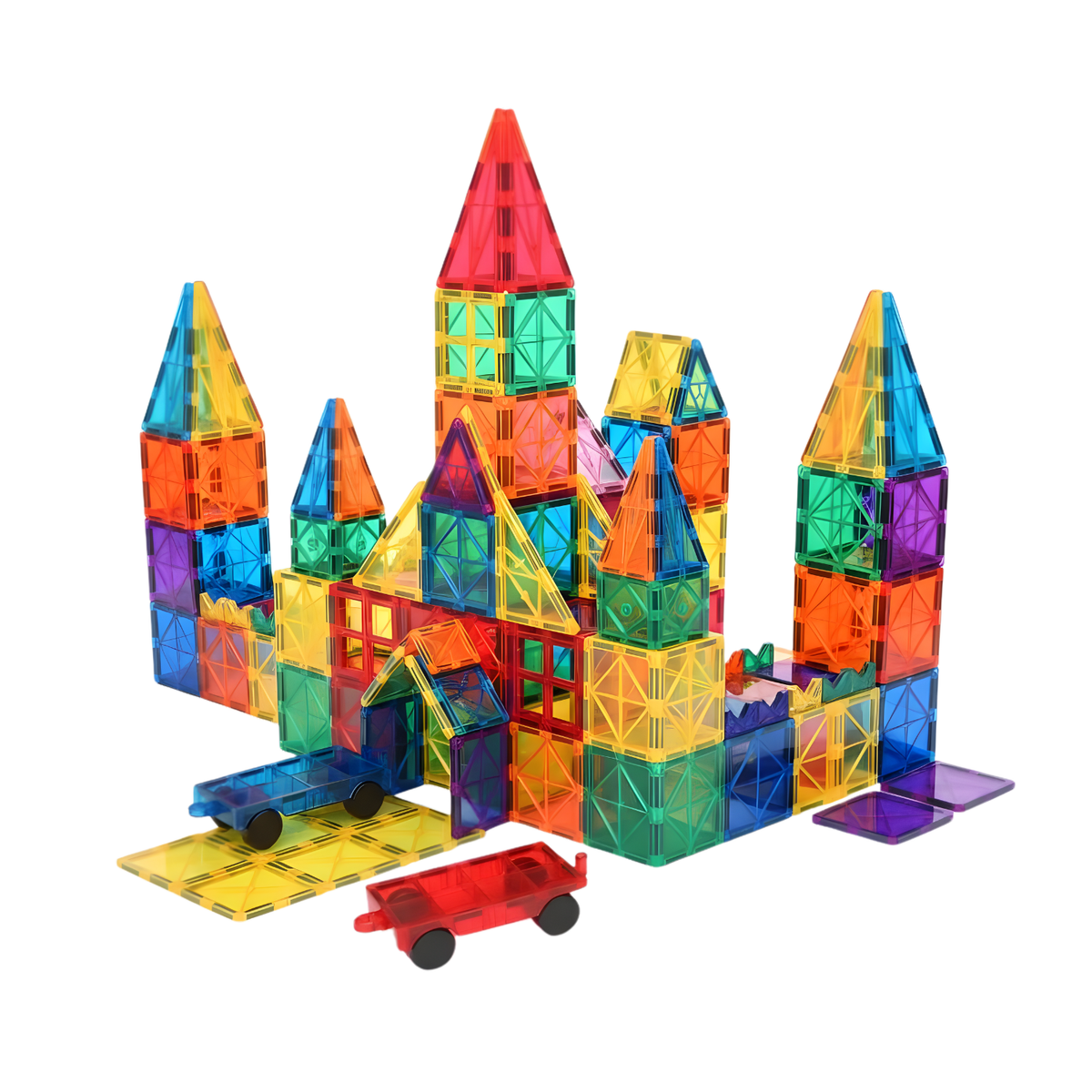
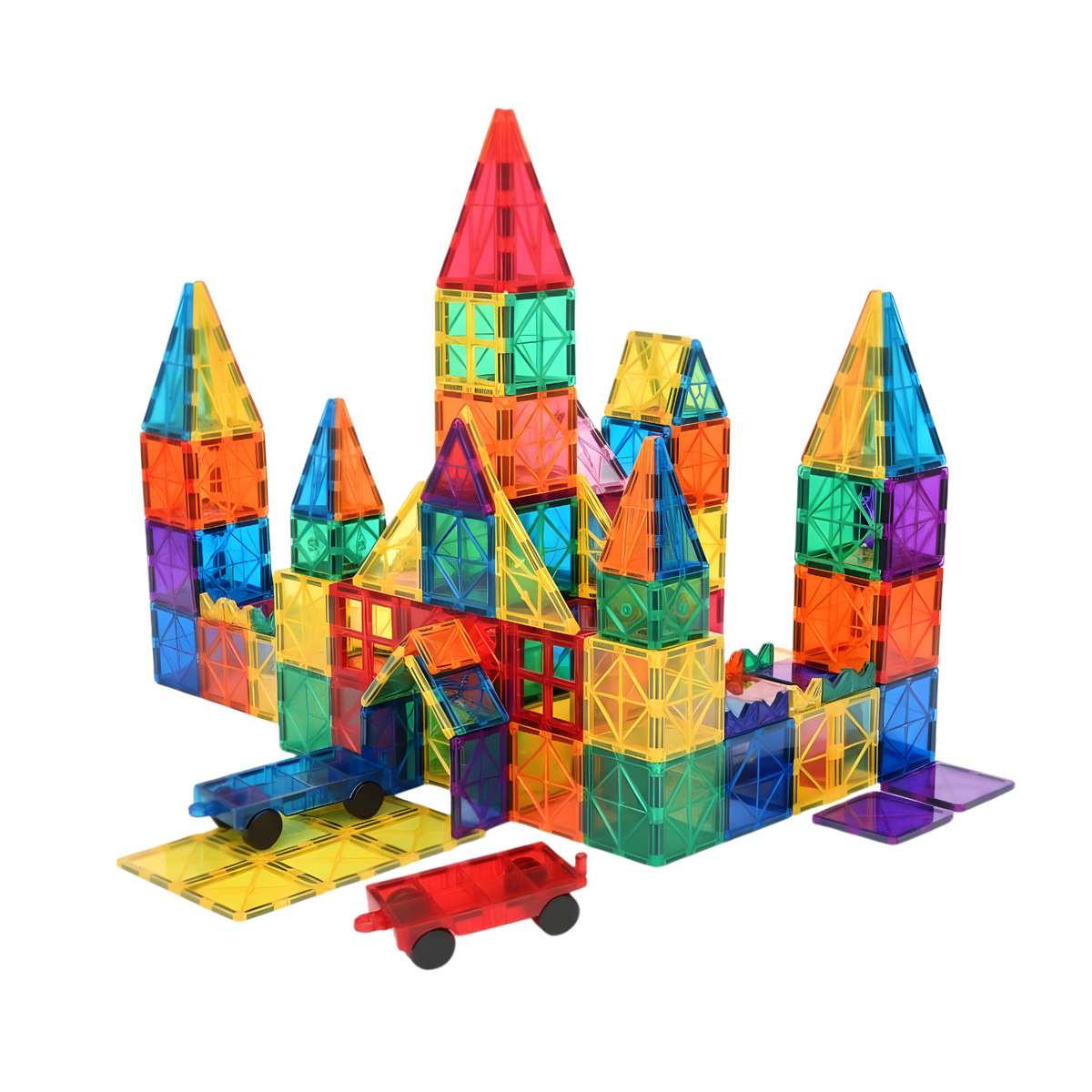
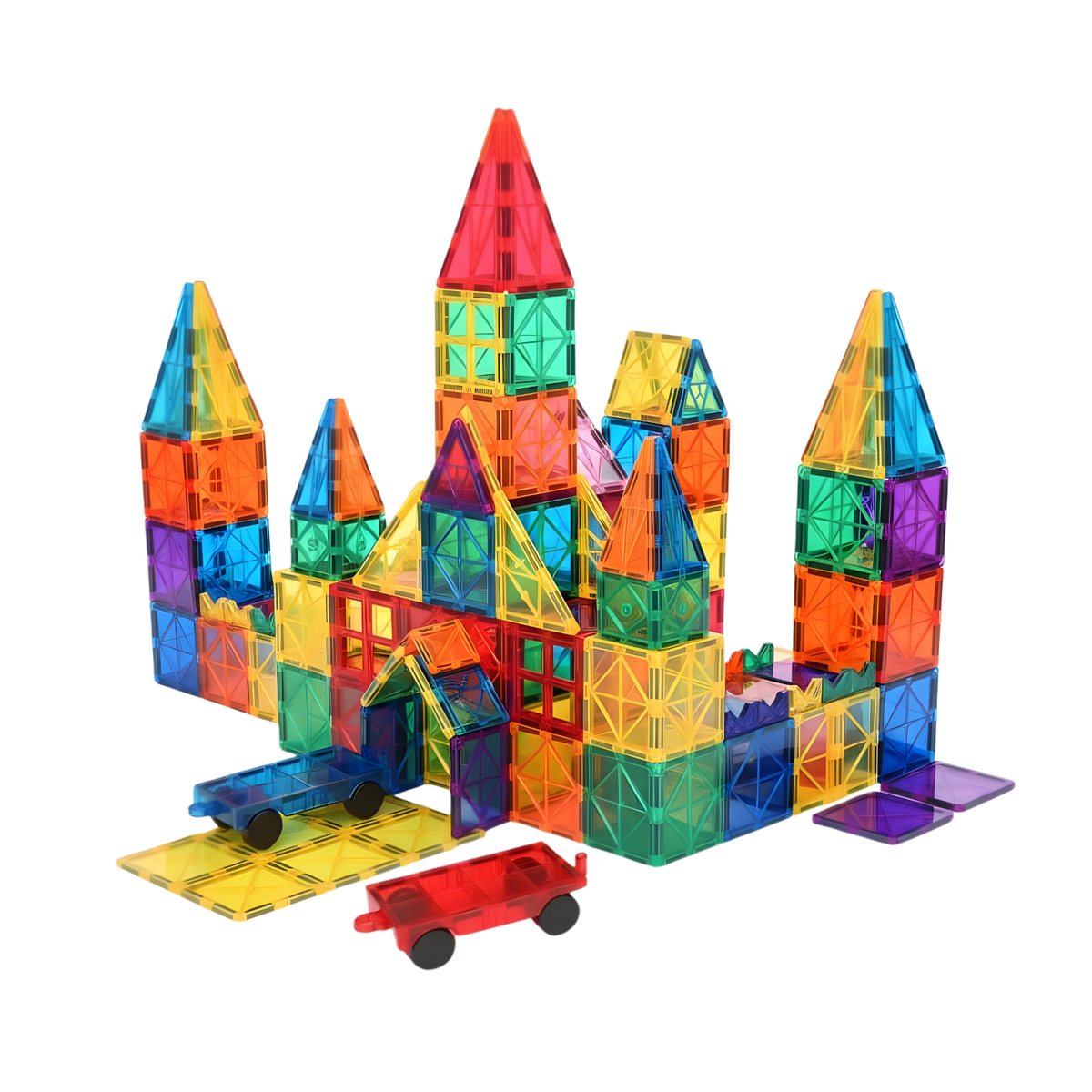
Magnetic tiles are flat shapes that click together. With them, your child can build flat patterns on the floor or stand the shapes up into houses, towers and tunnels. Because the tiles connect through magnets, the building feels immediate: pieces snap into place without the fiddly pressing that frustrates smaller hands.
That immediacy is the main reason they work well for this age group. Your child spends the time on the idea instead of struggling with the connection. Tilesminds sets use strong magnets, and the pieces are made from recycled plastic and non-toxic material. The sets are suitable from age 3 (3+), so a four-year-old is well within range.
Our pick: Magnetic Tiles 125 Pieces
If you want one set that covers most of what a four-year-old will want to do, start with the Magnetic Tiles 125 Pieces set. It is priced at €42.00, and the tiles are flat pieces, not cubes.
Here is why it fits the question you started with:
- It has no fixed theme. The set is not tied to a character or a storyline, so the story comes from your child. A tower can become a castle one day and a garage the next.
- It gives your child room to plan. With 125 pieces, a four-year-old can build something big enough to be proud of, without running out of tiles halfway through.
- It supports play alone and together. Two children can share one set and each build their own part of a bigger scene.
- It stays useful as your child grows. The set is listed for ages 3 to 12, so the same tiles can carry more complex builds as your child gets older.
For a first set that is meant to last, this is the one we point most parents to.

What a four-year-old actually does with tiles
It helps to picture the play before you buy. Here are a few typical stages you might see at home.
Flat building on the floor
Many children start by laying tiles flat and joining them into patterns. This is a good moment to talk about shapes, colours and symmetry in a relaxed way. You do not need to teach. Asking “what happens if you add another one here?” is usually enough.
Standing things up
Next comes the first house or tower. This is where children discover what holds and what falls. Because the pieces click together, the structures are more forgiving than loose stacking, and your child can keep going after a small mistake.
Building for a story
Around four, building often turns into pretend play. A house needs a family, a garage needs a car. This is where small add-ons come in, which we cover below.
How many pieces do you really need?
This is the question parents ask most, so here is a straightforward way to think about it.
- One child, short sessions: a smaller set can work. The Magnetic Tiles 48 Pieces set costs €29.99 and is a good way to try the idea.
- One child, longer sessions: the Magnetic Tiles 64 Pieces set at €29.99 gives a little more room to build.
- Bigger builds or more than one child: the 125-piece set is the one to choose. More tiles means fewer arguments over who gets the last square.
In our experience, parents who start with a very small set often end up buying a second one. If you think your child will take to it, starting with 125 pieces usually saves you that second order.
Tiles versus blocks: they are different products
Tilesminds also sells magnetic blocks. These are cubes, not flat tiles, and they are a different kind of product. They are not interchangeable with tiles, and they build in a different way: you stack and connect solid shapes rather than folding flat shapes into walls.
If your child loves the look of block worlds, the Magnetic Blocks ICE 118 Pieces set has an ice and Minecraft theme and costs €29.99. The Magnetic Blocks 104 Pieces set also has a Minecraft theme, at €34.99.
These themes are a good fit if your child already knows and loves that style. If you want the most open-ended option, with no theme attached, flat tiles are the simpler choice.
Add-ons that extend the play
Once your child has a base set, small extras can add a story layer without replacing the open-ended core.
- Magnetic Cars 2 Pieces (€14.99) is an add-on that gives builds something to drive through.
- Magnetic Figures 4 Pieces (€14.99) adds small characters for pretend play.
If your child prefers racing, the Magnetic Race Track Orbit 153 Pieces set at €34.99 has a race track and orbit theme. It suits a child who already knows they want to build tracks. For a first set, we would still choose the more open-ended tiles.
If your child loves princess stories, the Magnetic Tiles Princess Set 50 Pieces at €22.99 is a tile set with a princess theme.
Setting up play the Montessori way
The toy is only half of it. How you present it makes a big difference.
- Use a low shelf or a basket. When your child can see and reach the tiles, they can start without asking you.
- Keep the choice small. A few toys on display get more attention than a full toy box.
- Give a clear play space. A rug or a low table gives the building a defined area, and makes tidying up easier.
- Step back. Offer a question rather than a solution. “How could you make that taller?” often works better than showing how.
- Let your child tidy up. Sorting tiles back into a box is a small job that builds independence.
Common mistakes when buying for this age
A few things we see often:
- Buying by label. A “Montessori” sticker does not tell you whether a toy is open-ended. Check how it is played with.
- Choosing a set that is too small. Children at this age tend to build bigger as they get confident.
- Starting with a heavy theme. Themes are fun, but they can narrow the play. A theme-free set leaves more room for your child’s own ideas.
- Buying too much at once. One good set, played with deeply, beats five sets played with briefly.
The short version
The best Montessori toys for 4 year olds are the ones your child can pick up, understand and shape into something of their own. They do not need to be fancy, and they do not need to tell a story for your child.
If you want one purchase that does this well, the Magnetic Tiles 125 Pieces set offers enough tiles for ambitious builds, no theme to limit the play, and ages 3 to 12 so it keeps its value. Add a small extra later if your child asks for one.
Magnetic Tiles 125 Pieces · €42.00
Frequently asked questions
Are magnetic tiles Montessori toys?
Montessori is an approach to learning rather than a certification. Magnetic tiles fit its spirit because they are open-ended and child-led. Your child decides what to build, and there is no single correct result.
Are Tilesminds magnetic tiles suitable for a 4 year old?
Yes. Tilesminds sets are suitable from age 3 (3+), so a four-year-old is within the age range. The sets are listed for ages 3 to 12.
How many magnetic tiles does a 4 year old need?
It depends on how your child plays. A set of 48 or 64 pieces works for shorter, smaller builds. The 125-piece set gives more room for bigger builds and for playing with a sibling or friend.
What is the difference between magnetic tiles and magnetic blocks?
Tiles are flat shapes that click together, while blocks are cubes. They are different products and cannot replace each other. Tiles are the more open-ended choice, and some block sets come with a theme such as Minecraft.
What are Tilesminds magnetic tiles made of?
Tilesminds products are made from recycled plastic and non-toxic material, and they use strong magnets to connect the pieces.