If you are searching for Montessori materials, you probably want toys that invite your child to explore, concentrate and build at their own pace. You also want fewer things that blink, beep and get abandoned after a day. Open-ended building toys fit that wish well, and magnetic tiles are one of the most flexible options you can put on a shelf.
In this guide you will find what people usually mean by Montessori materials, how to judge a toy against those ideas, and where our Magnetic Tiles 125 Pieces set fits in. We will also be clear about what these tiles are and are not.
What people mean by Montessori materials
Montessori materials are the learning tools used in Montessori education. Many are made for one specific purpose, such as a set of graded cylinders or a number rod. At home, most parents use the term more loosely. They mean toys and tools that follow a few shared ideas.
- Child-led: your child decides what to do and for how long.
- Simple and uncluttered: few features, no screens, nothing that plays for them.
- Hands-on: the child works with their hands and sees the result right away.
- Open-ended: there is no single correct way to play.
- Easy to tidy: children can fetch and put away materials themselves.
When you shop for Montessori materials with this list in mind, you can judge any toy on its merits instead of relying on a label.
Are magnetic tiles Montessori materials?
To be straightforward: Tilesminds magnetic tiles are not official Montessori materials, and we do not claim any Montessori approval or certification. What we can say is that they suit a Montessori-inspired way of playing. A child can sort, stack, build and rebuild without instructions, and no pattern or outcome is imposed on them.
That makes them a good partner to the more traditional materials you may already own. Wooden puzzles and practical life tools build precision. Magnetic tiles add free, three-dimensional construction on top of that.

What to look for in Montessori materials for home
Before you buy anything, check a toy against these points.
Does it work in many ways?
A good open-ended toy grows with your child. A three-year-old might simply click tiles together and pull them apart. An older child might plan a tower, a house or a small town. If the toy only has one function, it tends to get boring quickly.
Does your child control the result?
The best materials let the child be the one who makes things happen. With tiles, the child chooses the colours, the shape and the size of the build. There is no battery deciding what comes next.
Is it made with care?
You will want to know what a toy is made of. Our tiles are made from recycled plastic, and the material is non-toxic. They also use strong magnets, so builds hold together instead of sliding apart, which matters when a young child is still developing fine motor control.
Does it suit your child's age?
Our sets are suitable from age 3 (3+), and the sets listed here are intended for children aged 3 to 12. That wide range is one reason a single set can stay in use for years.
Why Magnetic Tiles 125 Pieces fits this idea
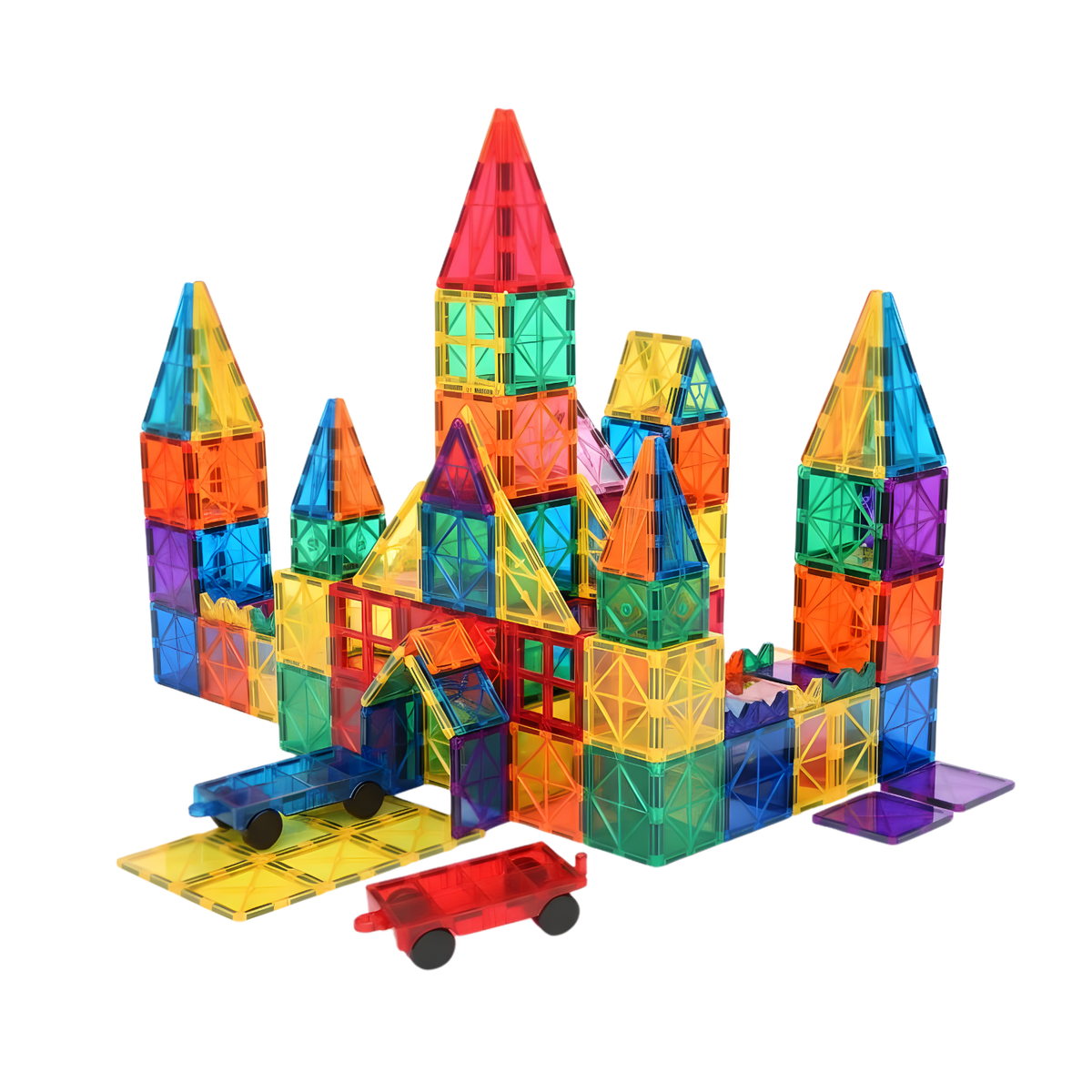
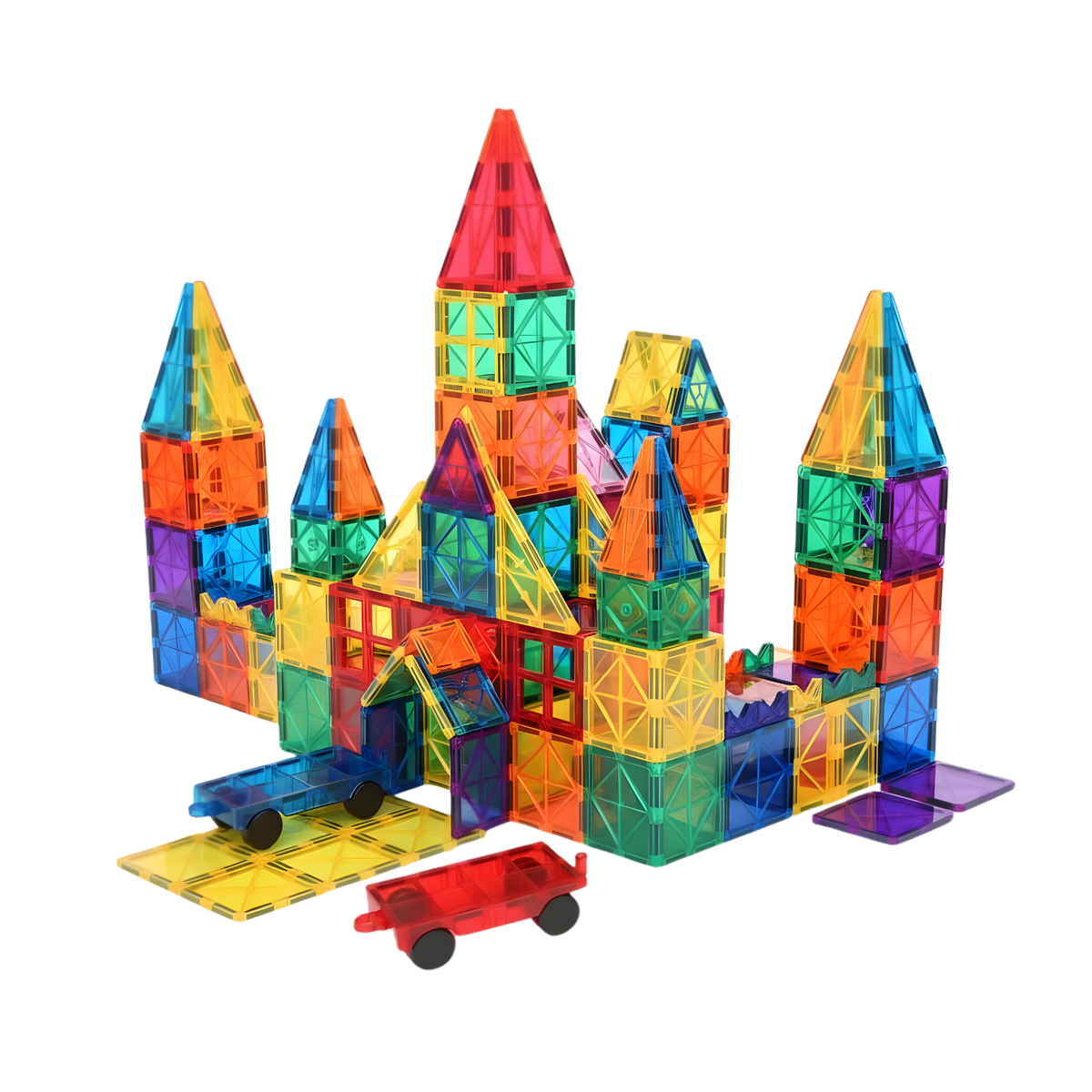
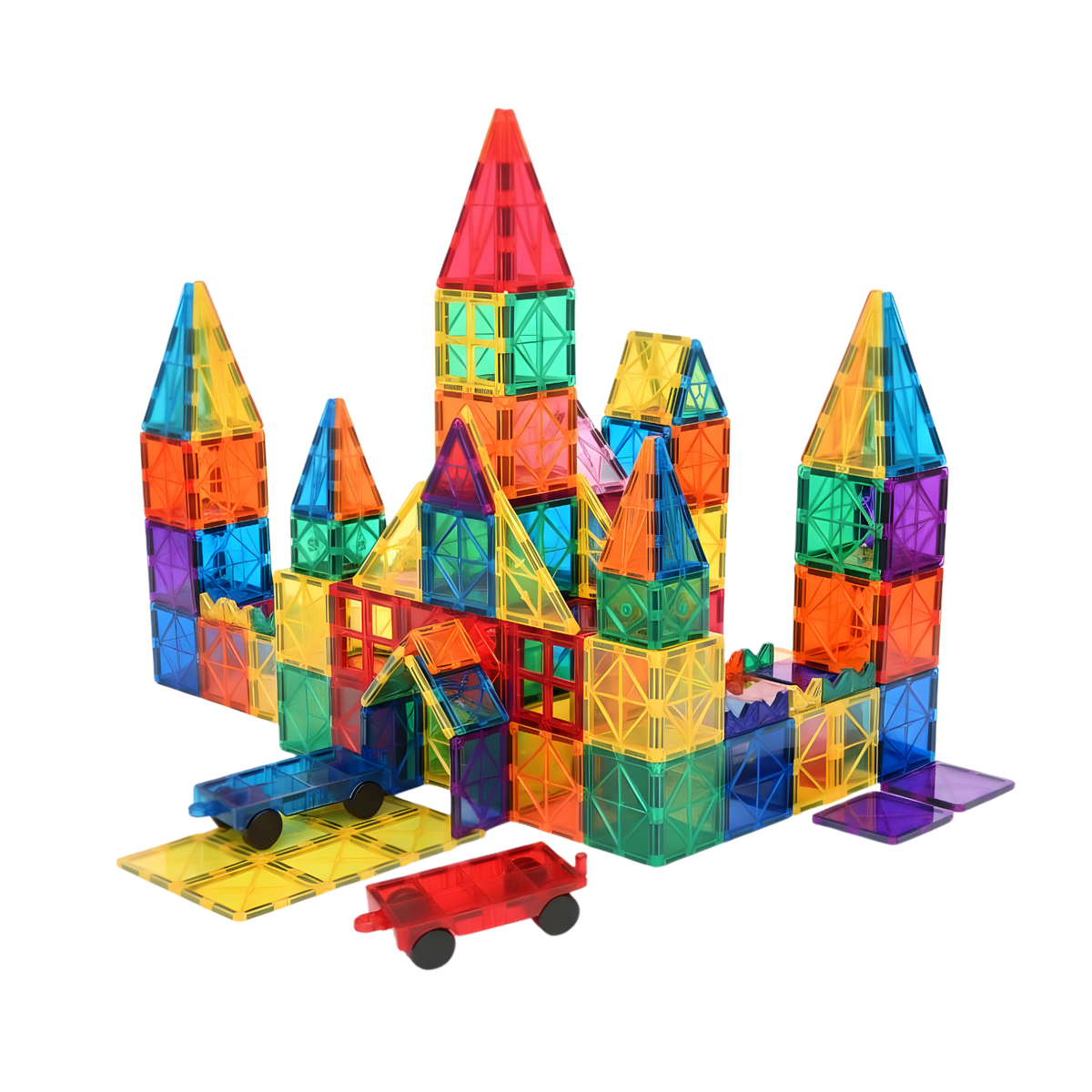
Our Magnetic Tiles 125 Pieces set is the one we suggest first to parents looking for open-ended, Montessori-style play. It is a set of flat tiles with no fixed theme, so it does not tell your child what to build. It is currently €42.00.
125 pieces give room for real projects
With a small set, builds stay small. With 125 pieces, your child can make a tall tower, a large house with rooms, or a long structure that spreads across the floor. More pieces also mean two children can build side by side without fighting over tiles. If you have siblings or regular playdates, that matters.
No theme means no script
Themed sets are fun, but they often point children toward one kind of play. This set has no theme, so the tiles can be a castle one day and a garage the next. That fits the Montessori idea of leaving the imagination to the child.
Strong magnets, quick feedback
When tiles snap together firmly, your child gets instant feedback. A wall stands, or it does not. They see how a base affects height and how a shape holds up. They learn by doing, without you needing to explain anything.
Recycled plastic, non-toxic material
The tiles are made from recycled plastic and from non-toxic material. For many parents, this is as important as the play value, particularly with younger children who handle everything.

How to introduce magnetic tiles in a Montessori-inspired way
How you present the toy matters nearly as much as the toy itself. These simple habits help.
- Start with a few tiles. Put out a small selection on a tray or mat instead of tipping out the whole set. Add more as your child gets comfortable.
- Keep them visible and reachable. A low shelf with a basket lets your child choose the tiles on their own and put them away again.
- Let them lead. Resist the urge to build a perfect house for them. Sit nearby, watch and answer questions if they ask.
- Talk about what you see. Say "you made a tall tower" instead of "that's beautiful". It encourages them to describe their own work.
- Rotate the toy. If the tiles go away for a week and come back, they often feel new again.
Simple play ideas to get started
You do not need a plan, but a few starting points can help if your child is unsure.
- Sort by colour. A good first activity for the youngest builders.
- Build a flat shape, then fold it up. Laying tiles out flat and lifting them into a form is a satisfying trick.
- Make a home for a toy. A shelter for a favourite soft toy gives the build a purpose.
- Build the tallest tower possible. Children quickly discover how to make a wide base.
- Build together. Take turns adding one tile at a time and see what appears.
Choosing the right set size
The right number of pieces depends on your child, the space you have and how many children will play. We offer several tile sets, all made from recycled plastic and non-toxic material.
- Magnetic Tiles 48 Pieces (€29.99): a compact starting point for a first set and for smaller play spaces.
- Magnetic Tiles 64 Pieces (€29.99): a bit more room for taller or wider builds.
- Magnetic Tiles 125 Pieces (€42.00): the largest plain tile set, and the one that suits shared play or ambitious projects.
If your child will play mostly alone, a smaller set can work well. If you have more than one child, or you want a set that your child will not outgrow, the 125-piece set is the better long-term choice. Buying the larger set at once also avoids ending up with two partial sets later.
Tiles or blocks: they are different products
Tiles are flat pieces. Blocks are cubes. They are different kinds of product and they do not replace each other, so choose based on the kind of building you want to encourage.
Tiles suit hollow structures: walls, roofs, houses and towers. Blocks suit solid, compact builds and pixel-style creations. Our Magnetic Blocks 104 Pieces (€34.99) are cubes with a pixel-style theme, which is a different kind of play from a plain tile set. If your child likes pixel-art and building in grids, blocks are worth a look. If you want the most open-ended starting point, begin with tiles.
Extras that add to the play, not replace it
Once your child is comfortable with tiles, small additions can give new ideas without cluttering the shelf.
- Magnetic Figures 4 Pieces (€14.99) let your child create small stories inside their buildings.
- Magnetic Cars 2 Pieces (€14.99) add movement, and children often build garages and roads for them.
These are add-ons, so you will need a tile set to get the most from them. If your child loves princess stories, the Magnetic Tiles Princess Set 50 Pieces (€22.99) is a tile set with a princess theme. It is more themed than the plain sets, so it works well as a second set rather than as a first, open-ended one.
Is it worth buying for a Montessori-style home?
If you want toys that stay in use, the answer is often yes. Open-ended toys tend to last longer in a child's routine because the play changes as the child does. A tile set that a three-year-old uses to click and stack can later become a tool for planning and designing.
Here is a quick way to decide:
- You want one toy that suits several ages: choose the 125-piece set.
- You are testing whether your child enjoys building: the 48 or 64-piece set is a modest first step.
- You want a pixel-style, grid-like building toy: look at blocks, a different product from tiles.
- You want to extend a set you already have: figures and cars are easy additions.
For most families who come to us looking for Montessori materials for home, we suggest starting with the Magnetic Tiles 125 Pieces set. It has no theme, a generous piece count, strong magnets, and it is made from recycled plastic and non-toxic material. It suits children from age 3 (3+), which means it will not be put away after a few months.
A few final tips
- Supervise younger children according to your own judgement and the age guidance on the product page.
- Keep the tiles in one open basket, so your child can see everything at a glance.
- Give your child a flat, clear area to build, such as a mat or a low table.
- Let builds stay up for a day or two when you can. Children often return to a structure and improve it.
Montessori materials are really about trust: giving children good tools and letting them find their own way. A set of magnetic tiles can be a simple, flexible tool for exactly that.
Magnetic Tiles 125 Pieces · €42.00
Frequently asked questions
Are Tilesminds magnetic tiles official Montessori materials?
No. They are not official Montessori materials and we do not claim any Montessori certification. They are open-ended building toys that suit a child-led, Montessori-inspired way of playing.
What age are the magnetic tiles suitable for?
Our magnetic tiles are suitable from age 3 (3+). The sets mentioned in this article are intended for children aged 3 to 12.
What are the tiles made of?
They are made from recycled plastic and from non-toxic material, and they use strong magnets to hold builds together.
Which set is best for a Montessori-style home?
We recommend the Magnetic Tiles 125 Pieces set. It has no theme, so your child decides what to build, and the large piece count allows bigger projects or shared play.
What is the difference between magnetic tiles and magnetic blocks?
Tiles are flat pieces, while blocks are cubes. They are different products and cannot replace each other. Tiles suit walls, roofs and hollow structures, and blocks suit compact, solid builds.
Can I add figures or cars to a tile set?
Yes. Magnetic Figures 4 Pieces and Magnetic Cars 2 Pieces are add-ons that work alongside a tile set and add story and movement to your child's builds.