Finding good gifts for preschoolers is harder than it looks. Children between three and five change fast. A toy that fascinates them in March can be ignored by June, and the shelf fills up with things that were played with twice. If you are buying for your own child, a niece, a nephew or a friend's little one, you probably want something that gets used, not something that gets admired and forgotten.
This guide covers what makes a gift work at this age, and why a set of magnetic tiles is a sensible choice. We look closely at our Magnetic Tiles 48 Pieces set, and at when a bigger or themed tile set makes more sense.
What makes a good gift for preschoolers
Before comparing products, it helps to know what you are looking for. Most toys that last in a preschooler's life share a few traits.
It works for more than one kind of play
A preschooler rarely plays the same way two days in a row. One day they want to build a tower, the next day a house for their dinosaurs, and the day after that a bed for a teddy. Toys with a single purpose tend to run out of steam. Open-ended toys give the child room to decide what the game is.
It needs very little explanation
A three-year-old does not read instructions. A good gift can be opened, understood and used within a minute. That is better for the child, and it is better for you, because you are not stuck at the kitchen table decoding a manual while they get restless.
It can be played with alone or together
Preschoolers often switch between solo play and wanting a parent or sibling beside them. A toy that supports both is more useful than one that only works with a partner or only works alone.
It stays relevant for longer than a few weeks
If you are choosing a gift, you want it to last. Toys that can be used simply at three and in a more ambitious way at five or six give you much more for your money.
Why magnetic tiles suit this age group
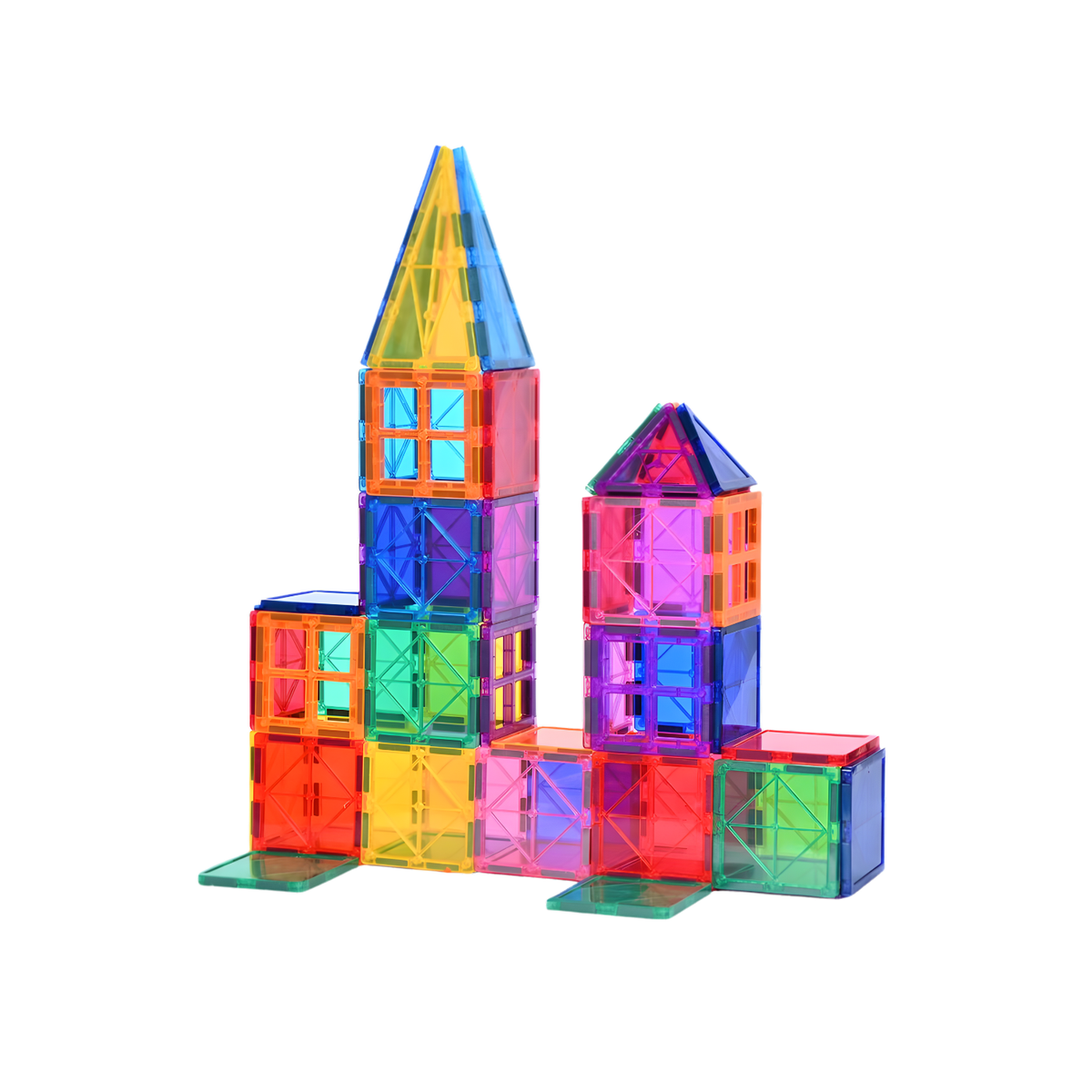
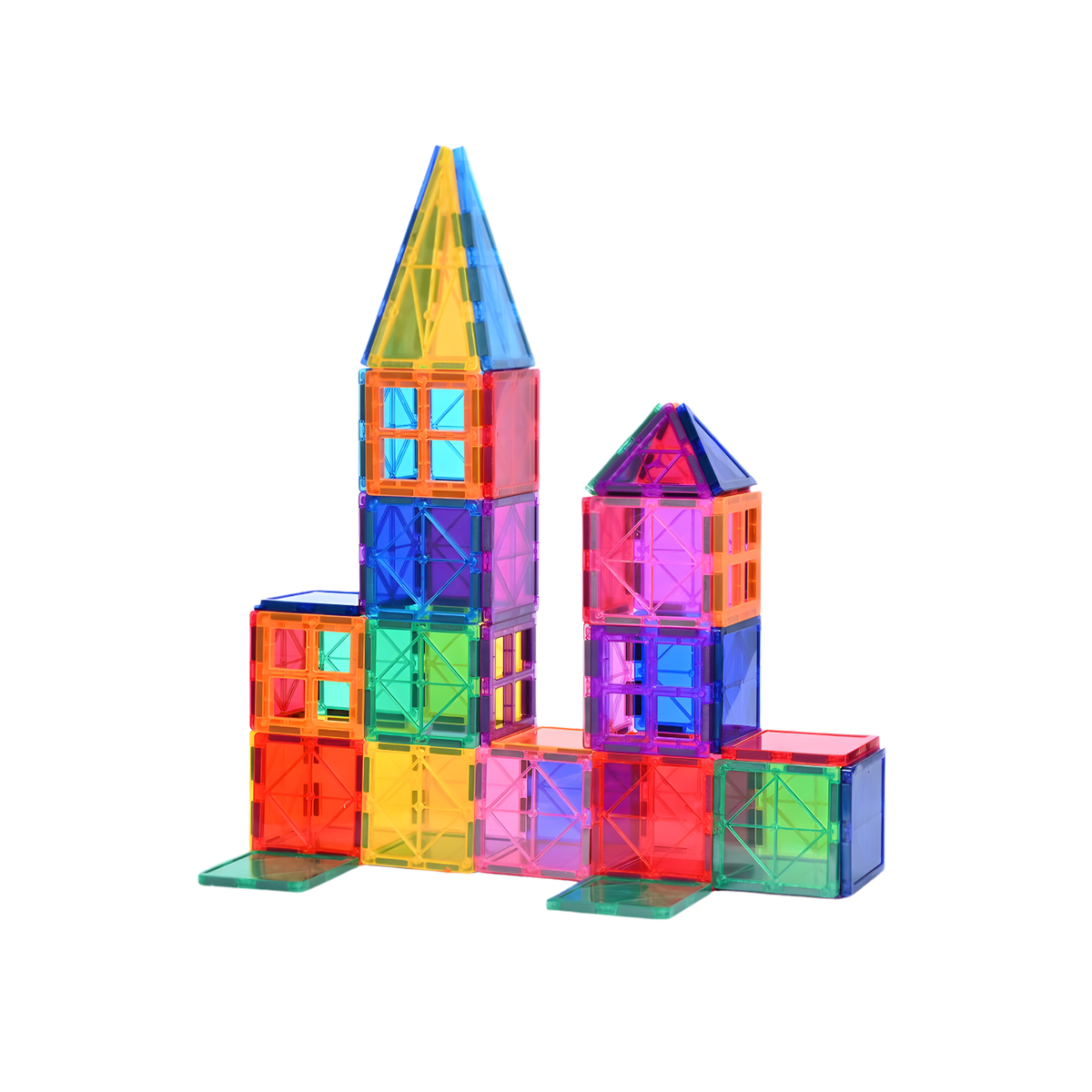
Magnetic tiles are flat shapes that connect at the edges. You click them together to form walls, roofs, floors and larger structures. Because the pieces snap into place, a young child can build something that stands up without needing steady fingers or a lot of patience.
That is a big part of the appeal for preschoolers. Stacking loose blocks can end in frustration when the tower tips over. With tiles that click together, the child gets a result quickly, and a quick result keeps them going. Our sets use strong magnets, so the connections are easy for small hands to make.
The pieces are made from recycled plastic and from a non-toxic material, which matters to many parents who want to know what their child spends hours handling. The sets are suitable from age 3 (3+), so they fit right into the preschool years.

The gift we would point you to: Magnetic Tiles 48 Pieces
If you want one clear answer, our Magnetic Tiles 48 Pieces set is where we would start. It is priced at €29.99, and it gives a child plenty to work with from the very first day.
Enough pieces to build something real
With 48 tiles, a child can make more than a flat pattern. They can build a house they can put toys into, a tall tower, a tunnel, a garage or a simple castle. You do not need hundreds of pieces to see the toy work, and that is why 48 is a sensible size for a first set.
A size that is easy to live with
A very large set can feel like a lot for a three-year-old to take in. It also takes more space to store and more time to tidy. A set of 48 is large enough to be satisfying, and manageable enough that you can realistically pack it away at the end of the day.
Simple enough for three, interesting enough for five
A younger preschooler will mostly click tiles together, make flat shapes and then fold them into boxes and towers. An older preschooler starts planning. They decide on a house with two rooms, a roof and a door, and then try to build exactly that. The same set supports both stages, which is what you want from a gift that should last.
How preschoolers tend to play with tiles
It helps to picture what happens after the gift is opened. Every child is different, but this is a typical pattern as they grow.
- Around age 3: exploring how the tiles click, making flat patterns, building small boxes and simple towers, and knocking things down on purpose.
- Around age 4: building enclosures for toy animals, naming what they are making, and starting to build with a plan in mind.
- Around age 5: more detailed structures, role play around what they built, and building together with a sibling or friend.
You may also find that the best moments come when you sit down and build next to them for ten minutes. Ask what the building is for, who lives in it and what happens next. That is often where the storytelling starts, and it costs you nothing.

Choosing the right size: 48, 64 or 125 pieces
Magnetic tiles come in several set sizes, and it is worth thinking about who the gift is for before you pick one.
Start with 48 if it is a first set
If the child has never played with magnetic tiles, the 48-piece set gives them what they need to get going. It is also a good choice for a birthday gift when you want something that feels generous without being overwhelming.
Go up to 64 if you want a little more room
If you know the child likes to build big, or you expect two children to share the set, the Magnetic Tiles 64 Pieces set gives you more pieces to work with. It is the same kind of product, just with more tiles in the box, and it is priced at €29.99.
Choose 125 for siblings or a long-term set
For a family with more than one child, or if you want a set that keeps up with bigger and more ambitious builds, the Magnetic Tiles 125 Pieces set is the largest of our tile sets. It is priced at €42.00. If you are unsure, it is usually easier to start with a smaller set and add to it later than to buy more than the child needs right away.
If the child has a favourite theme
Some children already know exactly what they like. If you are buying for a child who loves princesses, our Magnetic Tiles Princess Set 50 Pieces is a tile set with a princess theme, priced at €22.99. It is still a set of tiles, so it works in the same way as the 48-piece set, but it comes with the theme built in.
If you have no idea what the child likes, a plain tile set is the safer choice. It does not tie the child to one idea, and they can decide for themselves what to build.
Practical tips before you buy
- Check what the child already has. If they own a set of tiles, a bigger set may be a better gift than a second starter set.
- Think about space. Choose a set that fits the storage you have. A simple box or basket is usually enough.
- Plan to play together at first. A few minutes of building with the child on the first day often decides whether the toy becomes a favourite.
- Buy for the next year, not only for today. A set that works for a three-year-old and still interests a six-year-old is better value than one that is outgrown quickly.
- Keep the gift simple. One good set tends to be played with more than three average ones.
Is a 48-piece set the right gift?
For most families buying gifts for preschoolers, the answer is yes. It is a clear, practical choice: easy to understand, open-ended, made from recycled plastic, from a non-toxic material and with strong magnets, and suitable from age 3 (3+). It gives a child enough pieces to build real structures and keeps storage and tidying realistic.
If you already know the child will share the set or likes to build big, go up to 64 or 125 pieces. If they are mad about princesses, choose the themed set. If you are not sure, the Magnetic Tiles 48 Pieces set is the one we would put in the box.
Magnetic Tiles 48 Pieces · €29.99
Frequently asked questions
What age are magnetic tiles suitable for?
Our magnetic tile sets are suitable from age 3 (3+), so they fit the preschool years well.
How many tiles should I buy as a gift for a preschooler?
For a first set, 48 pieces is a practical size. If the child likes to build big or will share with a sibling, the 64-piece or 125-piece set gives more room.
What are the tiles made from?
They are made from recycled plastic and from a non-toxic material, and they use strong magnets to connect.
Is a themed set better than a plain set?
Only if you know the child loves the theme. A plain set is more open-ended, while the Princess Set 50 Pieces suits a child who already loves princesses.
Can two children play with one set?
Yes, but a larger set such as the 64-piece or 125-piece one gives each child more pieces to build with.